















Picture this: it’s a Friday night, your restaurant is fully booked, and suddenly your walk-in cooler starts making a strange noise. Within hours, the temperature creeps up. By morning, hundreds of dirhams’ worth of fresh produce, dairy, and proteins are spoiled — and you’re facing a health inspection with a warm refrigerator and a very expensive repair bill. This nightmare scenario plays out in commercial kitchens across the hospitality industry far more often than it should, and almost every time, it was preventable.
Implementing consistent refrigeration maintenance tips for commercial kitchens is one of the most impactful decisions any restaurant owner or kitchen manager can make. It’s not just about keeping food cold — it’s about protecting your business, your customers, and your bottom line. Refrigeration failures lead to food waste, failed health inspections, costly emergency repairs, and in worst cases, foodborne illness outbreaks that can permanently damage your reputation.
In this comprehensive guide, we’ll walk you through everything you need to know about commercial fridge maintenance: from daily cleaning routines and temperature monitoring to professional restaurant refrigeration servicing schedules and energy-saving strategies. Whether you run a small café, a high-volume hotel kitchen, or a catering operation, these insights are tailored for the real demands of horeca refrigeration care.
Why Refrigeration Maintenance Tips for Commercial Kitchens Are Non-Negotiable
Commercial refrigeration equipment is among the most heavily used and most expensive assets in any foodservice operation. Unlike a household fridge that opens a dozen times a day, a commercial unit may be accessed hundreds of times during a single shift — exposing it to temperature fluctuations, door seal wear, dust buildup on condensers, and compressor stress that accumulates rapidly over time.
The consequences of neglecting kitchen cooling maintenance are both financial and operational:
- Food Safety Risks: When refrigeration fails to maintain temperatures below 5°C (41°F), bacteria multiply rapidly in the “danger zone,” putting customers at risk of foodborne illness and exposing your business to legal liability.
- Energy Costs: A poorly maintained refrigerator can consume up to 30–40% more electricity than a well-maintained unit, according to the U.S. Department of Energy. In a high-electricity-cost market like the UAE, this adds up fast.
- Equipment Lifespan: Refrigeration units that receive regular servicing last significantly longer — often 15–20 years — while neglected units may fail within 7–10 years, requiring expensive early replacement.
- Regulatory Compliance: Health authorities in the UAE and globally require documented food storage temperature logs. A failing refrigerator puts your food hygiene certification at risk.
- Operational Disruption: An emergency breakdown during service hours can halt kitchen operations entirely, affecting revenue, staff morale, and customer satisfaction.
Understanding and applying refrigeration maintenance tips for commercial kitchens is therefore not optional — it’s an essential part of professional kitchen management and horeca refrigeration care.
Understanding How Commercial Refrigeration Systems Work
Before diving into maintenance routines, it’s valuable to understand the basic mechanics of commercial refrigeration. This knowledge helps kitchen staff identify early warning signs and communicate effectively with service technicians.
The Core Components of Commercial Refrigeration
A commercial refrigeration system consists of several interconnected components that work together in a continuous cycle:
- Compressor: The “heart” of the system — it compresses refrigerant gas, raising its temperature and pressure before sending it to the condenser.
- Condenser Coils: Located at the back or bottom of the unit, these coils release heat from the refrigerant into the surrounding air. Dirty condenser coils are the number one cause of refrigeration failure in commercial kitchens.
- Evaporator Coils: These absorb heat from inside the refrigerator compartment, keeping the interior cold. Frost buildup on evaporator coils reduces efficiency significantly.
- Expansion Valve: Controls the flow of refrigerant into the evaporator, regulating cooling capacity.
- Door Gaskets: The rubber seals around refrigerator doors that prevent warm air from entering and cold air from escaping.
- Fans and Motors: Circulate air within the unit to maintain uniform temperatures throughout the storage space.
- Thermostat and Controls: Electronic or mechanical controls that regulate temperature settings and defrost cycles.
Why Each Component Needs Attention
Each component has a specific failure mode that regular maintenance can prevent or detect early. For example, condenser coils clogged with grease and dust cause the compressor to work harder, shortening its life and increasing energy consumption. Damaged door gaskets allow warm air infiltration that forces continuous compressor cycling. Understanding this helps prioritize your commercial fridge maintenance checklist.
Refrigeration Maintenance Tips for Commercial Kitchens: The Complete Daily Routine
Daily maintenance habits are the foundation of a robust kitchen cooling maintenance program. They take only minutes but prevent the majority of problems that lead to costly breakdowns.
1. Monitor and Log Temperatures Twice Daily
Every commercial kitchen should have a written temperature log for each refrigeration unit. Check and record temperatures at the start and end of each shift — ideally using a calibrated thermometer rather than relying solely on the unit’s built-in display. Refrigerators should maintain between 1°C and 4°C (34°F–40°F), while freezers should stay at -18°C (0°F) or below.
Deviations of even 2–3 degrees from the target range can indicate a developing problem. Catching this early is one of the most effective refrigeration maintenance tips for commercial kitchens — it allows intervention before food safety is compromised and before a minor issue becomes a major repair.
2. Inspect Door Gaskets Daily
Run your hand along the door seals of every refrigerator and freezer unit each morning. Feel for cold air escaping or warm spots — signs that the gasket is cracked, torn, or has lost its elasticity. A simple “paper test” — closing the door on a sheet of paper — can verify seal integrity: if the paper slides out easily, the gasket needs replacement.
Damaged gaskets are both a food safety issue and an energy drain. They cause the compressor to run almost continuously, dramatically increasing electricity costs and wear on the compressor motor. Replacement gaskets are inexpensive and straightforward to install, making this one of the highest-ROI commercial fridge maintenance tasks available.
3. Check for Condensation and Frost Buildup
Unusual condensation on the exterior of a refrigerator, or excessive frost inside a freezer unit, signals a problem with airflow, door seals, or the defrost cycle. Address these issues immediately rather than waiting for the next scheduled service — excessive frost on evaporator coils acts as insulation and can reduce cooling efficiency by 20% or more.
4. Keep the Area Around Units Clear
Commercial refrigerators need adequate airflow around their condenser coils to function efficiently. Ensure there is at least 15–20cm of clearance on all sides of the unit. In busy kitchen environments, equipment, packaging, and cleaning supplies tend to accumulate around refrigerators — a daily sweep to keep these areas clear is a simple but effective kitchen cooling maintenance habit.
Keep Your Kitchen Equipped with Professional-Grade Tools
Shop Best Kitchen Accessories & More in UAE
Weekly Commercial Fridge Maintenance Tasks Every Kitchen Must Complete
Beyond daily checks, a structured weekly routine addresses the gradual buildup issues that daily inspections alone cannot catch. These tasks require a slightly longer time investment but are critical to long-term equipment health.
Clean Condenser Coils Weekly
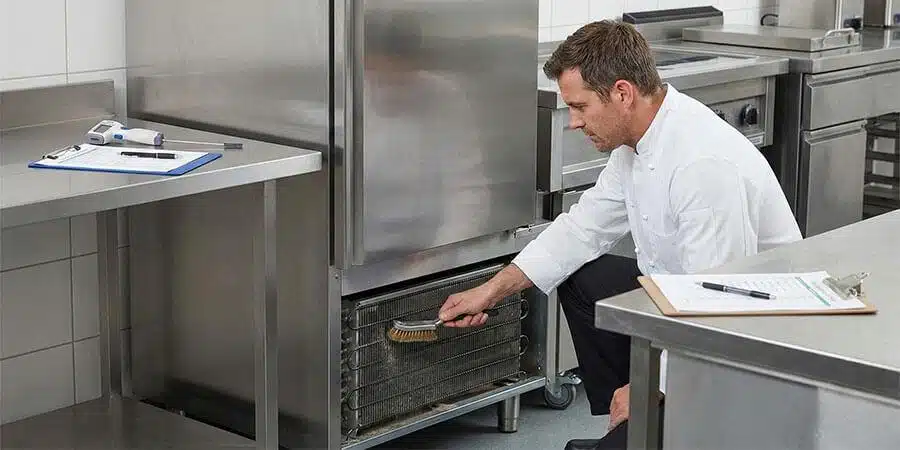
In a commercial kitchen environment — especially in locations like the UAE where ambient temperatures can exceed 40°C — condenser coils accumulate grease, dust, and airborne particles at an accelerated rate. Clogged condenser coils are the single most common cause of commercial refrigeration failure, yet cleaning them takes only 15–20 minutes with a soft brush and a vacuum.
To clean condenser coils:
- Switch off the refrigeration unit or disconnect power.
- Locate the condenser coils (typically at the back or beneath the unit).
- Use a soft brush or coil cleaning brush to loosen debris.
- Vacuum away loosened dust and debris thoroughly.
- For grease buildup, use a commercial coil cleaning spray approved for food-service environments.
- Restore power and monitor temperature for 30 minutes to confirm normal operation.
This single weekly task can reduce energy consumption by up to 15% and dramatically extend compressor lifespan — making it one of the most impactful refrigeration maintenance tips for commercial kitchens you can implement immediately.
Clean Interior Surfaces and Shelving
Spills, expired products, and packaging debris inside refrigerators create unsanitary conditions and can harbor bacteria even at refrigeration temperatures. Remove all contents weekly, wipe down interior walls, shelves, and floors with a food-safe sanitizer, and ensure proper airflow is maintained by avoiding overpacking shelves.
Pay special attention to drain pans and drainage holes. Blocked drains cause water accumulation inside the unit, leading to bacterial growth, unpleasant odors, and potential damage to the refrigerator floor. Pour a small amount of warm water into the drain to verify it flows freely.
Inspect Fan Blades and Motors
Check evaporator and condenser fans weekly for unusual noise, vibration, or visible damage to fan blades. A damaged fan blade can cause vibration that stresses bearings and motor mounts, leading to premature failure. Fan motors should run smoothly and quietly — any grinding, squealing, or intermittent running is cause for immediate professional attention.
Monthly Restaurant Refrigeration Servicing Checklist
Monthly maintenance goes deeper into the mechanical and electrical systems of your refrigeration equipment. Some of these tasks require a trained technician, while others can be handled by a competent kitchen maintenance manager.
Professional Refrigerant Level Check
Refrigerant (also called freon or coolant) is the substance that carries heat out of the refrigerator. Low refrigerant levels — typically caused by a slow leak — cause the unit to work harder, consume more energy, and ultimately fail to maintain safe temperatures. Refrigerant handling and recharging must be performed by a licensed HVAC/refrigeration technician, as refrigerants are regulated substances.
During monthly restaurant refrigeration servicing, a technician should check refrigerant pressure and inspect the system for leaks using an electronic leak detector. Early detection of refrigerant leaks saves both refrigerant costs and prevents compressor damage from running low.
Check Electrical Connections and Controls
Loose or corroded electrical connections are a significant cause of refrigeration failures. Monthly, a technician should inspect terminal connections at the compressor, fans, and control board — tightening any loose connections and replacing corroded terminals before they cause electrical faults or shorts.
Test Defrost Cycle Operation
Most commercial refrigerators and freezers have an automatic defrost cycle that periodically melts frost buildup on evaporator coils. If this cycle malfunctions — either running too frequently, not at all, or failing to complete — the result is either excessive frost buildup or abnormal temperature swings. Monthly testing of defrost cycle timing and completion is an important part of commercial fridge maintenance.
Calibrate Thermostats and Temperature Controllers
Electronic thermostats can drift over time, displaying temperatures that don’t accurately reflect actual conditions inside the unit. Monthly calibration verification — comparing the thermostat display against a calibrated probe thermometer — ensures that your temperature logs are accurate and that food safety is genuinely maintained.
Equip Your Commercial Kitchen with the Right Containers for Safe Food Storage
Seasonal and Annual Horeca Refrigeration Care Strategies
Beyond routine maintenance, seasonal and annual service appointments address the deeper mechanical health of your refrigeration investment and are essential for long-term horeca refrigeration care.
Pre-Summer Deep Service in the UAE Context
In the UAE and GCC region, the summer months — from May through September — place extreme demands on commercial refrigeration systems. Ambient temperatures regularly exceed 45°C, forcing refrigeration units to work at or beyond their designed capacity for months at a time. Scheduling a thorough professional service in April — before peak temperatures arrive — is critical for any HORECA operation in this climate.
A pre-summer service should include:
- Complete condenser coil cleaning and inspection
- Refrigerant pressure check and top-up if needed
- Comprehensive electrical system inspection
- Door gasket replacement if any wear is detected
- Compressor performance assessment
- Verification of all safety cut-outs and alarms
Annual Compressor and Mechanical Inspection
The compressor is the most expensive component in any refrigeration system — replacement costs for commercial compressors can range from AED 2,000 to AED 15,000 or more, plus labor. Annual inspection by a qualified refrigeration engineer assesses compressor health, checks operating pressures and temperatures against manufacturer specifications, and identifies wear before catastrophic failure occurs.
Annual service is also the right time to assess whether aging equipment should be replaced. A unit that requires more than AED 2,000–3,000 in annual repairs is generally reaching the end of its cost-effective service life.
Energy Efficiency: Kitchen Cooling Maintenance That Saves Money
Properly maintained refrigeration equipment doesn’t just last longer — it operates more efficiently, reducing electricity consumption and lowering your monthly operating costs. In a market where energy prices are significant, the financial return on kitchen cooling maintenance investment is compelling.
Temperature Setting Optimization
Many commercial kitchens set refrigerators colder than necessary, believing this provides an extra safety margin. In reality, setting refrigerators to 1°C rather than 3°C can increase energy consumption by 10–15% with no meaningful food safety benefit. Verify that all units are set to the optimal range for their contents:
| Unit Type | Optimal Temperature Range | Common Mistake |
| Refrigerator (general) | 1°C – 4°C (34°F – 40°F) | Set too cold (0°C or below) |
| Dairy/Deli | 1°C – 3°C (34°F – 37°F) | Set too warm (>4°C) |
| Produce | 4°C – 7°C (40°F – 45°F) | Set too cold (chilling damage) |
| Freezer | -18°C – -22°C (0°F – -8°F) | Set unnecessarily low (-25°C) |
| Ice Cream/Frozen Desserts | -20°C – -25°C (-4°F – -13°F) | Set too warm (soft texture) |
Minimize Door Open Time
Every time a refrigerator door opens, warm, humid kitchen air rushes in. In a busy kitchen, this happens hundreds of times per day. Training staff to minimize door-open time — retrieving multiple items in a single trip, keeping frequently accessed items at eye level, and ensuring doors close fully after each use — can meaningfully reduce compressor workload and energy consumption.
Avoid Placing Hot Food Directly in Refrigerators
Placing hot food directly into a refrigerator forces the unit to work overtime to bring the temperature down, stresses the compressor, and can raise the temperature inside the unit to unsafe levels for other stored food. Always cool hot food to below 21°C within two hours using an ice bath or blast chiller before refrigerating.
Explore Professional Kitchen Appliances for Your HORECA Operation
Shop Best Kitchen Appliances in UAE
Food Safety Compliance and Refrigeration Maintenance Tips for Commercial Kitchens
In the UAE, food business operators are subject to the UAE Food Safety Law (Federal Law No. 10 of 2015) and local emirate regulations enforced by the Dubai Municipality, Abu Dhabi Agriculture and Food Safety Authority (ADAFSA), and other relevant bodies. Refrigeration compliance is a core component of food hygiene inspections.
Documentation Requirements
Inspectors expect to see:
- Temperature logs going back at least 30 days
- Records of maintenance activities and service visits
- Evidence of corrective action taken when temperatures deviated from safe ranges
- Staff training records for temperature monitoring procedures
HACCP-Based Refrigeration Controls
Under HACCP (Hazard Analysis and Critical Control Points) principles — which underpin UAE food safety regulations — refrigeration temperature control is typically identified as a Critical Control Point (CCP). This means that exceeding the temperature limit constitutes a critical limit violation requiring documented corrective action. A robust commercial fridge maintenance program directly supports your HACCP plan compliance.
Staff Training: Making Refrigeration Maintenance Tips for Commercial Kitchens Part of Your Culture
Equipment and schedules matter — but culture matters more. The most comprehensive maintenance checklist in the world is worthless if kitchen staff don’t follow it consistently. Building a kitchen culture where refrigeration care is everyone’s responsibility requires intentional training and accountability structures.
Onboarding Training for New Kitchen Staff
Every new kitchen employee — regardless of their role — should receive basic training on refrigeration procedures during onboarding:
- How to read and record temperatures correctly
- What constitutes a temperature deviation and who to report it to
- Proper loading practices (not overfilling, correct placement of items)
- Door usage discipline (minimize open time, ensure full closure)
- What to do if the unit sounds or appears abnormal
Assigning Maintenance Ownership
In well-run commercial kitchens, specific maintenance tasks are assigned to named individuals — not just “the morning shift.” When a person’s name is attached to a task, accountability increases significantly. Create a simple laminated checklist posted inside each refrigerator door, signed off daily by the responsible team member. This also provides the documentation trail that health inspectors expect.
Discover Essential Cooking Tools for a High-Performance Kitchen
Shop Best Cooking Tools in UAE
Choosing the Right Service Partner for Restaurant Refrigeration Servicing
Not all refrigeration technicians are equal — especially when it comes to commercial-grade equipment used in HORECA environments. Selecting the right service partner is as important as the maintenance itself.
What to Look for in a Commercial Refrigeration Service Provider
- Manufacturer certifications: Look for technicians certified to service the brands of equipment you use (e.g., Hoshizaki, True, Interlevin, Electrolux Professional).
- HORECA experience: A provider who primarily services residential equipment may not understand the unique demands and compliance requirements of commercial kitchen environments.
- Emergency response capability: Refrigeration failures don’t respect business hours. Confirm that your service partner offers emergency call-out within 2–4 hours, 24 hours a day, 7 days a week.
- Spare parts availability: Technicians who carry common spare parts — compressors, start relays, fan motors, gaskets — can complete most repairs in a single visit rather than leaving you without refrigeration while they source parts.
- Service contracts: A planned maintenance contract that includes scheduled visits plus priority emergency call-out is almost always more cost-effective than reactive repair-only arrangements.
When to Replace Rather Than Repair: A Practical Guide
Even with excellent horeca refrigeration care, every piece of equipment eventually reaches the end of its practical service life. Knowing when to invest in replacement rather than ongoing repairs is an important financial decision for any kitchen operator.
Signs That Replacement Is More Cost-Effective Than Repair
- Annual repair costs exceed 30% of the unit’s current replacement cost
- The compressor has failed once — a second compressor failure is rarely worth repairing
- Refrigerant leaks are recurring and cannot be permanently sealed
- The unit is more than 12–15 years old and requires significant repair
- Energy consumption has increased significantly despite maintenance — may indicate internal insulation degradation
- Replacement parts are no longer available from the manufacturer
When selecting new refrigeration equipment, invest in units with high energy efficiency ratings (look for Energy Star certification where applicable), appropriate capacity for your volume, and strong manufacturer warranty and service network support in the UAE.
GN Containers and Proper Food Storage: The Connection to Kitchen Cooling Maintenance
Effective refrigeration maintenance isn’t only about the equipment — it’s also about how food is stored inside it. Using proper GN containers (Gastronorm containers) is an important element of professional food storage that directly impacts how hard your refrigeration equipment has to work and how safely food is maintained.
GN containers in standard sizes allow efficient, organized stacking that maximizes usable refrigerator space while maintaining proper airflow around stored food. Overpacked, irregular storage with non-standard containers reduces internal airflow, creates warm spots, and forces the refrigerator to work harder to maintain even temperatures throughout the compartment.
Optimize Your Food Storage with Professional GN Containers
Shop Best GN Containers in UAE
Frequently Asked Questions
How often should commercial refrigerators be serviced?
Commercial refrigerators should receive a professional service inspection at least every 6 months, with monthly internal checks by trained kitchen staff. In high-heat climates like the UAE, quarterly professional servicing is recommended due to the additional strain on refrigeration systems during summer.
What temperature should a commercial refrigerator be set at?
Commercial refrigerators should maintain a temperature between 1°C and 4°C (34°F–40°F) for general food storage. Freezers must stay at -18°C (0°F) or below. These ranges comply with UAE food safety regulations and international HACCP standards.
How do I know if my commercial refrigerator’s condenser coils need cleaning?
Signs that condenser coils need cleaning include the unit running continuously without cycling off, the refrigerator not maintaining its set temperature, the exterior of the unit feeling unusually warm, or increased electricity consumption. In a commercial kitchen, condenser coils should be cleaned at least weekly.
What causes a commercial refrigerator to stop cooling?
The most common causes are: dirty or blocked condenser coils, a failing compressor, low refrigerant due to a leak, a faulty thermostat or temperature controller, damaged door gaskets causing warm air infiltration, or a malfunctioning evaporator fan. Most of these issues are preventable with regular refrigeration maintenance tips for commercial kitchens.
How do I clean commercial refrigerator door gaskets?
Clean door gaskets weekly with a mild detergent and warm water solution, using a soft cloth or brush to get into the folds of the gasket where mold and debris accumulate. Rinse with clean water and allow to dry. Inspect for cracks or tears — a damaged gasket should be replaced immediately, not just cleaned.
Can I perform refrigeration maintenance myself, or do I need a professional?
Daily and weekly tasks — temperature logging, gasket inspection, condenser coil cleaning, interior cleaning — can and should be performed by trained kitchen staff. However, refrigerant handling, electrical repairs, compressor servicing, and defrost system diagnosis require a licensed refrigeration technician. Attempting refrigerant work without certification is illegal in most jurisdictions.
How long do commercial refrigerators last with proper maintenance?
With consistent preventive maintenance and prompt attention to developing issues, commercial refrigerators typically last 15–20 years. Neglected units often fail within 7–10 years, requiring costly early replacement. The return on investment from regular commercial fridge maintenance is substantial over the equipment’s lifetime.
What is the most common refrigeration problem in commercial kitchens?
Dirty condenser coils are by far the most common and most preventable cause of commercial refrigeration problems. They account for a significant proportion of all refrigeration service calls and can be largely avoided through weekly cleaning as part of a routine kitchen cooling maintenance program.
How can I reduce my restaurant’s refrigeration energy costs?
The most effective strategies include: keeping condenser coils clean, ensuring door gaskets seal properly, setting temperatures to the optimal (not excessively cold) range, minimizing door-open time, avoiding placing hot food directly in the unit, and scheduling regular professional servicing. These measures combined can reduce refrigeration energy consumption by 20–35%.
What should I do if my commercial refrigerator suddenly stops working during service?
First, check that the unit is receiving power (circuit breaker, plug, outlet). Check whether the condenser fan is running — if not, this may be a simple motor or fuse issue. Move temperature-sensitive food to another refrigerator immediately. Contact your refrigeration service provider for emergency call-out. Document the timeline and any food that may have been in the temperature danger zone for compliance records.
Is it worth getting a refrigeration service contract for my restaurant?
Yes — a planned maintenance contract almost always represents better value than reactive repairs. Service contracts provide scheduled preventive maintenance, priority emergency response, and often discounted parts and labor. For a busy HORECA operation, the operational risk of refrigeration failure during service makes this investment highly worthwhile.
Conclusion: Protect Your Kitchen with Consistent Refrigeration Maintenance Tips for Commercial Kitchens
Refrigeration is not just infrastructure — it’s the foundation of food safety, operational efficiency, and regulatory compliance in every commercial kitchen. The good news is that most refrigeration failures are entirely preventable with a disciplined approach to refrigeration maintenance tips for commercial kitchens: daily temperature monitoring, weekly condenser coil cleaning and gasket inspection, monthly professional servicing, and annual comprehensive technical reviews.
In the competitive and demanding HORECA environment of the UAE, the businesses that invest in preventive maintenance consistently outperform those that wait for problems to occur. They experience fewer emergency shutdowns, lower energy bills, longer equipment lifespans, and stronger food safety compliance records. They also demonstrate to their customers and health inspectors alike that they take food safety seriously — and that reputation is invaluable.
Whether you’re managing a single café refrigerator or a multi-unit walk-in system for a large hotel kitchen, the principles of horeca refrigeration care remain the same: inspect, clean, document, and service consistently. Start today — review your current maintenance routines, identify gaps, and commit to the schedule outlined in this guide. Your food, your customers, and your business depend on it.
Found this guide helpful? Share it with your kitchen management team, leave a comment with your experiences, or explore our related articles on professional kitchen appliances and food storage solutions to continue building a more efficient, compliant, and profitable foodservice operation.
Explore the Complete Range of HORECA Kitchen Equipment
Shop Best Kitchen Accessories & More in UAE


