















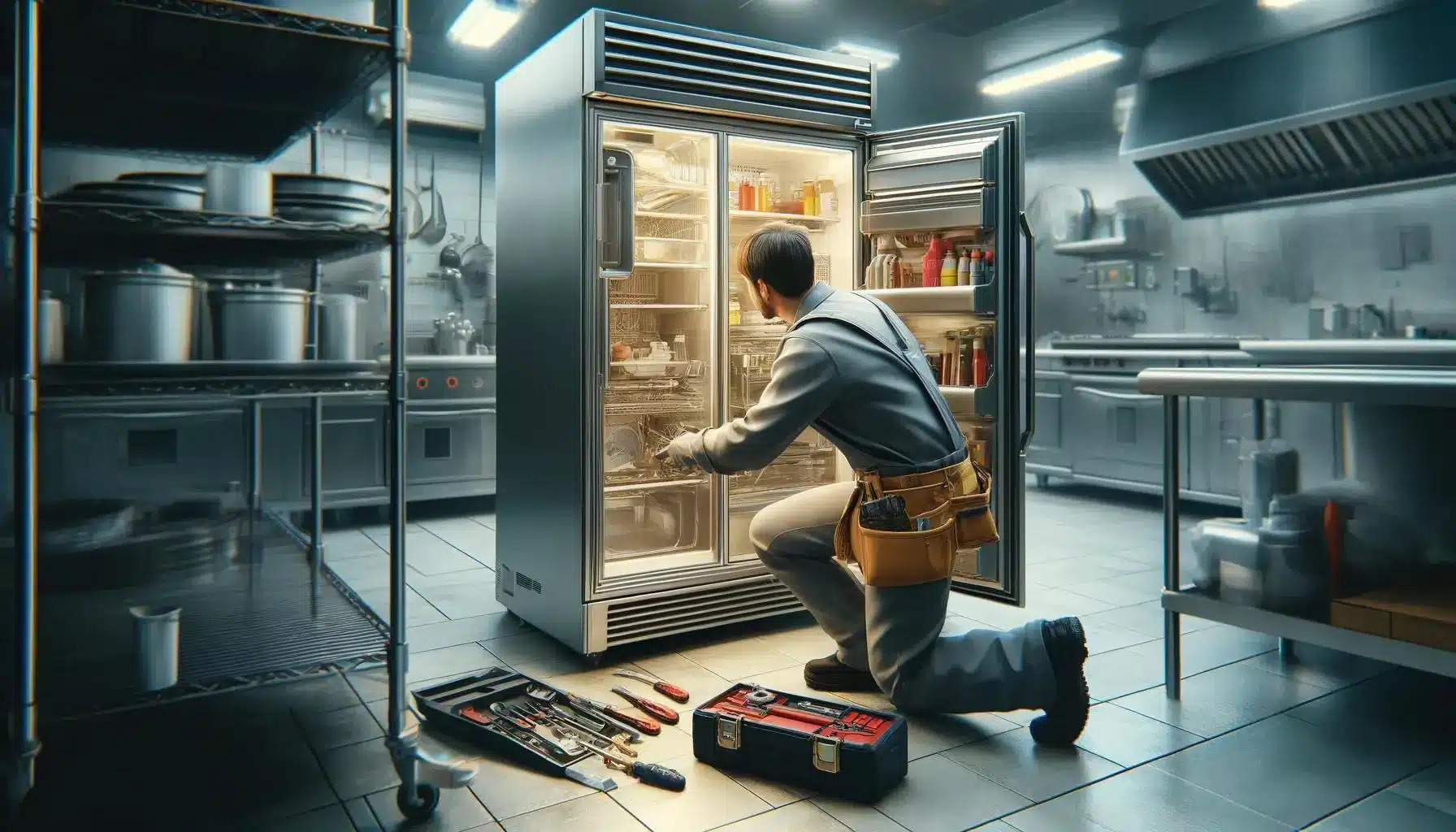
It was a busy Saturday lunch service when the head chef noticed something wrong. The reach-in refrigerator near the grill station felt warmer than usual. The interior thermometer was climbing — 6°C, then 8°C. The fish scheduled for the evening service was at risk. With 80 covers booked for dinner and no backup unit available, the entire kitchen ground to a tense, anxious standstill while the manager frantically called for an emergency technician. By the time help arrived, two trays of premium protein had to be discarded. The damage: hundreds of dirhams in wasted food, a missed dinner service, and a very unhappy owner — all from a problem that could have been identified and fixed days earlier.
Understanding the common refrigeration problems in restaurants is not a luxury for kitchen managers — it’s a survival skill. Commercial refrigeration failures are disruptive, expensive, and often entirely avoidable. The difference between a restaurant that catches issues early and one that faces emergency shutdowns almost always comes down to knowledge: knowing what signs to look for, what causes each problem, and what the right response is.
This comprehensive refrigeration repair guide covers every major issue you’re likely to encounter in a commercial foodservice environment — from the most frequent and simple to the more complex mechanical failures. Whether you’re doing your own first-pass restaurant refrigerator troubleshooting or preparing for a service technician’s visit, this guide gives you the knowledge to act fast and minimize damage.
Why Identifying Common Refrigeration Problems in Restaurants Early Saves Everything
In the HORECA industry, refrigeration is not just a convenience — it is a critical control point for food safety, regulatory compliance, and business continuity. A single refrigeration failure can result in:
- Food waste costs ranging from hundreds to thousands of dirhams, depending on what’s stored in the unit
- Service disruption that forces menu changes, customer disappointment, and revenue loss
- Regulatory consequences including health inspection failures, written warnings, or temporary closure notices from the Dubai Municipality or other authorities
- Emergency repair premiums — emergency call-outs outside business hours can cost two to three times standard service rates
- Reputational damage if a foodborne illness incident is traced back to a temperature failure in your kitchen
The most important insight in any refrigeration repair guide is this: refrigeration problems almost never appear without warning signs. They develop gradually, over days or weeks, giving observant kitchen teams ample opportunity to intervene before catastrophic failure. Learning to recognize those warning signs is the single most valuable skill in restaurant refrigerator troubleshooting.
Problem 1 — Not Cooling Properly: The Most Common Refrigeration Problem in Restaurants
A refrigerator that fails to maintain safe temperatures is the quintessential refrigeration emergency. But “not cooling properly” is a symptom, not a single problem — it can result from several different underlying causes, each requiring a different fix.
Cause: Dirty or Blocked Condenser Coils
This is the number one cause of cooling failure in commercial refrigerators and the most preventable. Condenser coils release heat from the refrigerant into the surrounding air. When they’re coated in grease, dust, and debris — which happens rapidly in commercial kitchen environments — they can’t dissipate heat efficiently. The refrigerant stays warm, the compressor overheats, and the unit’s cooling capacity drops dramatically.
How to fix it:
- Power down the unit safely.
- Access the condenser coils (typically at the back or beneath the unit).
- Use a soft coil cleaning brush to dislodge debris, then vacuum thoroughly.
- For grease-coated coils, apply a commercial coil cleaning spray and allow to soak before rinsing.
- Restore power and monitor temperature recovery over 30–60 minutes.
If cleaning the coils doesn’t restore cooling within two hours, the problem is likely compressor-related and requires professional attention.
Cause: Low Refrigerant (Refrigerant Leak)
Refrigerant leaks are one of the more serious commercial cooling issues because they require licensed professional intervention. Signs of a refrigerant leak include: the unit running continuously without reaching set temperature, ice forming on refrigerant lines, an oily residue near refrigerant connections, or a sweet or chemical odor near the unit.
How to fix it:
This is not a DIY repair. Contact a licensed refrigeration technician immediately. They will use an electronic leak detector to locate the leak, repair the breach, and recharge the system with the correct refrigerant type and quantity. Running a refrigerator on low refrigerant damages the compressor and will lead to complete system failure if not addressed promptly.
Cause: Faulty Thermostat or Temperature Controller
A failed thermostat can cause the unit to stop cooling entirely (if it incorrectly signals the compressor to stay off) or to overcool (if it fails to signal the compressor to cycle off). Symptoms include temperature readings that don’t match the actual thermostat setting, or a unit that runs continuously without reaching temperature.
How to fix it:
Verify the thermostat reading with a separate calibrated probe thermometer. If the readings differ significantly, the thermostat likely needs replacement — a relatively inexpensive repair. Thermostat replacement on most commercial units is a straightforward technical task for a qualified refrigeration service technician.
Keep Your Kitchen Running with Professional Kitchen Appliances
Shop Best Kitchen Appliances in UAE
Problem 2 — Excessive Frost or Ice Buildup: A Key Freezer Maintenance Problem
Frost buildup inside a freezer or refrigerator is one of the most common freezer maintenance problems in commercial kitchens and a reliable indicator that something in the system is working incorrectly.
What Normal vs. Abnormal Frost Looks Like
| Observation | Likely Cause | Action Required |
| Light frost on evaporator coils between defrost cycles | Normal operation | No action needed |
| Thick ice on evaporator coils that doesn’t clear after defrost | Defrost system failure | Professional service required |
| Ice or frost on interior walls and door | Damaged door gasket / excessive door opening | Inspect and replace gasket; review door procedures |
| Ice on refrigerant lines outside the unit | Low refrigerant / expansion valve issue | Professional service required immediately |
| Frost on food packaging near the back wall | Unit set too cold / items touching evaporator | Adjust temperature; rearrange food storage |
Cause: Defrost System Failure
Most commercial freezers use an electric defrost heater, defrost timer, and defrost termination thermostat working in concert to periodically melt frost from the evaporator coils. If any one of these components fails, frost accumulates unchecked — eventually blocking airflow through the evaporator and causing the unit to lose cooling capacity entirely.
How to fix it:
A qualified technician can test each defrost system component individually: the defrost timer (or electronic defrost control), the defrost heater (with an ohmmeter), and the defrost termination thermostat. Component replacement is generally straightforward and cost-effective. Allowing defrost failure to go unaddressed will eventually lead to complete evaporator blockage requiring a full manual defrost — a time-consuming process that takes the unit out of service for hours.
Cause: Damaged Door Gaskets
Warm, humid air entering through a damaged door gasket brings moisture that freezes on the evaporator coils and interior surfaces. In a busy commercial kitchen, gasket damage is extremely common — doors are opened frequently, often forcefully, and gaskets deteriorate through repeated use and cleaning chemical exposure.
How to fix it:
Inspect gaskets thoroughly — not just visually, but by feel. Run a finger along the entire gasket perimeter feeling for tears, cracks, hardened sections, or areas that have pulled away from the door frame. Replacement gaskets are available for most commercial refrigerator and freezer models and can be installed by a maintenance technician or, in some cases, by trained kitchen staff.
Proper Food Storage Starts with the Right Containers — Shop Now
Problem 3 — Water Leaking Inside or Around the Unit
Water pooling inside a commercial refrigerator or on the kitchen floor around the unit is a hygiene hazard, a slip risk, and a sign of a maintenance problem. This is one of the common refrigeration problems in restaurants that often gets dismissed as a minor inconvenience — until it causes a slip-and-fall incident or a failed health inspection.
Cause: Blocked Drain Line or Drain Pan
Commercial refrigerators have an internal drain system that channels condensation to a drain pan where it evaporates. When the drain line becomes blocked — by food debris, mold, or ice — water backs up and spills onto the floor of the refrigerator compartment or leaks out the bottom of the unit.
How to fix it:
- Remove all food and shelving from the unit.
- Locate the drain hole at the bottom of the refrigerator interior (usually at the back center).
- Use a pipe cleaner or a small amount of warm water to clear the blockage.
- Check the drain pan (usually accessible from the front bottom of the unit) — clean and dry it if water has accumulated.
- Verify the drain flows freely by pouring a small amount of warm water into the drain hole and observing it drain away.
Monthly drain cleaning should be part of every restaurant’s commercial cooling issues prevention routine. A dilute bleach solution or commercial drain cleaner safe for food equipment can prevent mold growth in the drain line.
Cause: Excessive Condensation on Door
Condensation forming on the exterior of refrigerator doors or around door frames is typically a sign of a door gasket problem or, in some cases, a failed anti-sweat heater (a small electric heater built into the door frame of many commercial units to prevent condensation). In the UAE’s humid climate, this problem is particularly common.
How to fix it:
Inspect and replace door gaskets as described above. If the gasket is intact, have a technician test the anti-sweat heater circuit — this is a simple, inexpensive repair that many kitchen managers overlook.
Problem 4 — Unusual Noises: What Your Refrigerator Is Trying to Tell You
Commercial refrigerators are not silent — they produce normal operational sounds including the hum of compressors, the click of thermostats cycling, and the whoosh of evaporator fans. Abnormal noises are a diagnostic tool that often identifies a developing problem before it causes failure.
Diagnosing Refrigerator Noises
| Noise Type | Likely Source | Urgency Level |
| Loud clicking or clunking on startup | Failing compressor start relay | High — service within 48 hours |
| Continuous high-pitched hum | Compressor running constantly (dirty coils, low refrigerant) | Medium-High — investigate cause |
| Rattling or vibrating | Loose panel, damaged fan blade, vibrating refrigerant line | Medium — inspect and tighten |
| Grinding or squealing | Failing fan motor bearings | High — service promptly |
| Gurgling or bubbling | Normal refrigerant flow sound | Low — normal operation |
| Banging or knocking | Compressor mounting loose; internal component loose | High — inspect immediately |
The key principle in restaurant refrigerator troubleshooting is: any noise that is new, louder than usual, or inconsistent with the unit’s normal operation is a signal that requires investigation. Don’t wait until the noise stops — it usually stops because the component has failed.
Equip Your Kitchen with Professional Cookware That Lasts
Problem 5 — Unit Runs Constantly Without Reaching Temperature
A commercial refrigerator that runs continuously without cycling off and without reaching its set temperature is working at maximum capacity just to maintain borderline safe temperatures. This is both an energy waste and a sign of imminent failure — the compressor running non-stop will eventually overheat and seize.
Systematic Restaurant Refrigerator Troubleshooting for Continuous Running
When a unit runs constantly, work through this diagnostic sequence before calling a technician:
- Check ambient temperature: Is the unit near a heat source — an oven, fryer, dishwasher, or direct sunlight? Moving the unit or adding thermal separation may resolve the issue.
- Inspect condenser coils: Are they clean and unobstructed? Dirty coils are the most common cause of continuous running.
- Check door gaskets: Are all doors closing fully and sealing properly? Even a slight gap causes continuous warm air infiltration.
- Verify the unit isn’t overpacked: Too much product blocks internal airflow, creating warm spots that the thermostat reads as requiring continuous cooling.
- Check thermostat setting: Is it set unrealistically cold for the ambient conditions?
- Listen to the compressor: Is it running normally, or does it sound labored? A hot-to-touch compressor body indicates overheating.
If none of these basic checks resolves the issue, the most likely causes are low refrigerant, a failing compressor, or a faulty expansion valve — all requiring professional refrigeration service.
Problem 6 — Ice Machine Problems in Commercial Kitchens
Ice machines are a subset of commercial refrigeration equipment with their own unique set of common refrigeration problems in restaurants. Given that ice is directly added to beverages served to customers, ice machine failures have direct food safety implications.
Low or No Ice Production
The most common ice machine complaint is insufficient ice output. Common causes include:
- Scale buildup on evaporator plates: Hard water mineral deposits (particularly common in UAE tap water) coat the evaporator plates and reduce ice-making efficiency. Regular descaling with a commercial ice machine cleaner is essential.
- Dirty condenser: Same principle as other refrigeration equipment — dirty condensers reduce cooling capacity and slow ice production.
- Water supply issues: Low water pressure, a partially closed inlet valve, or a clogged water filter reduces the water supply to the ice maker.
- Ambient temperature too high: Ice machines are rated to operate up to certain ambient temperatures. In UAE summer conditions, units installed without adequate ventilation may fail to produce at rated capacity.
Ice Has Bad Taste or Odor
Off-tasting or smelly ice is typically caused by mold, slime, or bacterial growth inside the ice machine’s water system or storage bin — problems that develop when machines aren’t cleaned on schedule. Commercial ice machines should be fully cleaned and sanitized at least every 6 months, more frequently in hot humid conditions.
Keep Ice Service Professional — Explore Bar and Coffee Accessories
Shop Best Coffee Accessories in UAE
Problem 7 — Door Not Closing or Sealing Properly
A refrigerator door that doesn’t close fully, doesn’t latch, or doesn’t seal is one of the simplest yet most damaging commercial cooling issues in any kitchen. Because the problem is often gradual — a gasket that slowly loses its elasticity rather than tearing suddenly — it can go unnoticed for weeks while quietly increasing energy consumption and compromising food safety.
Common Causes of Door Problems
- Worn or damaged door gaskets: The most common cause. Gaskets harden, crack, and compress over time, eventually losing the ability to form an airtight seal.
- Misaligned door: Heavy doors on walk-in coolers and reach-in units can become misaligned over time, particularly if the unit has been moved or if hinges have loosened. Door alignment adjustment usually requires a technician.
- Damaged latch or cam: The mechanical latch that holds the door closed can wear or break, preventing full closure. Replacement latches are generally available as spare parts.
- Bent or warped door panel: If a door has been forcefully opened against its travel limit, or something has struck it, the door panel may be deformed enough to prevent sealing.
The “Paper Test” for Door Seals
A quick and reliable DIY test for door seal integrity: close the refrigerator door on a piece of paper so the paper is between the door and the frame. If you can pull the paper out without resistance, the gasket is not sealing in that location. Test all four sides of every door monthly as part of your refrigeration repair guide procedures.
Store Food Safely with Professional GN Containers
Shop Best GN Containers in UAE
Problem 8 — Electrical Failures and Tripping Circuit Breakers
Commercial refrigeration equipment that repeatedly trips circuit breakers, blows fuses, or causes electrical faults is a serious safety issue that must be addressed urgently by a qualified electrician or refrigeration technician.
Common Electrical Causes
- Compressor motor drawing excessive current: A failing compressor motor draws more current than its rated amperage, eventually tripping the circuit breaker. This is typically a sign that the compressor is nearing end of life.
- Short circuit in defrost heater: Defrost heaters can develop ground faults or short circuits, particularly if moisture has entered the heater assembly.
- Corroded or loose electrical connections: Loose connections create resistance that generates heat and can cause arcing, tripping protection devices. This is both a reliability and a fire safety issue.
- Incorrect circuit sizing: If additional refrigeration equipment has been added to a circuit without proper electrical assessment, the total load may exceed the circuit’s capacity.
Critical safety note: Never simply reset a repeatedly tripping breaker without identifying and resolving the underlying cause. Repeated breaker trips indicate a genuine fault — resetting without investigation is a fire risk. This is one area of refrigeration repair guide work that must involve a licensed electrician.
Problem 9 — Temperature Fluctuations and Inconsistent Cooling
A refrigerator that cycles between too warm and too cold — rather than maintaining a stable temperature — creates both food safety risks and food quality problems. Fluctuating temperatures can cause partial thawing and refreezing in freezers, accelerate spoilage in refrigerators, and cause textural damage to temperature-sensitive products like dairy and fresh produce.
Causes of Temperature Instability
- Faulty thermostat or controller: The most common cause — a thermostat that cuts the compressor off too early (unit warms up) or too late (unit gets too cold).
- Overloading with warm product: Adding large quantities of warm product at once overwhelms the unit’s cooling capacity temporarily. In a well-run kitchen, hot food is chilled before refrigerating.
- Frequent door opening: High-traffic periods create temperature spikes inside the unit. Ensuring product organization minimizes search time with the door open.
- Failing compressor: A compressor that runs erratically — starts and stops irregularly — produces inconsistent cooling. Listen for irregular compressor cycling as a diagnostic clue.
Preventive vs. Reactive: The True Cost of Common Refrigeration Problems in Restaurants
Understanding the economics of refrigeration maintenance is one of the most compelling arguments for investing in preventive care. The following comparison illustrates why reactive maintenance is always more expensive than prevention:
| Scenario | Preventive Approach | Reactive Approach |
| Dirty condenser coils | Weekly cleaning: 20 min staff time, zero cost | Compressor replacement: AED 3,000–12,000 |
| Worn door gasket | Monthly inspection + AED 100–300 replacement gasket | AED 500–1,500 in monthly extra electricity + food loss |
| Refrigerant leak | Quarterly professional check: AED 300–500 | Emergency repair + compressor damage: AED 5,000–20,000 |
| Drain blockage | Monthly drain flush: 10 min, near zero cost | Slip incident, health inspection failure, remediation costs |
| Thermostat calibration | Monthly check: AED 0–100 | Food safety incident: AED 1,000+ in spoilage + possible closure |
The pattern is clear: investing in restaurant refrigerator troubleshooting and preventive maintenance returns far more than it costs. The ROI of a planned maintenance program for commercial refrigeration in the HORECA sector is typically measured in multiples, not percentages.
Upgrade Your Kitchen with Professional Utensils & Tools
Building Your Restaurant’s Refrigeration Repair Guide: A Quick-Response Protocol
Every restaurant kitchen should have a documented protocol for refrigeration failures — not improvised in the moment of crisis, but prepared in advance when there’s time to think clearly. Here is a template for a practical quick-response protocol:
Step 1: Immediate Assessment (First 5 Minutes)
- Check the current temperature against the set point.
- Determine how long the deviation has been occurring (review temperature logs).
- Check whether the power supply is functioning (breaker, plug, outlet).
- Listen for abnormal compressor or fan sounds.
- Check if other equipment on the same circuit has been affected.
Step 2: Food Safety Decision (Next 10 Minutes)
- If temperature has been above 8°C for more than 2 hours, food safety is compromised — do not serve affected products.
- If temperature has been rising but is still within safe range (<5°C), begin transferring most critical items (proteins, dairy, seafood) to a functioning unit immediately.
- Document the time of discovery, current temperature, and duration of deviation in writing.
Step 3: First-Level Troubleshooting (If Safe to Do)
- Inspect and clean condenser coils if visibly dirty.
- Check door gaskets for obvious damage.
- Verify the unit is not overloaded or blocked internally.
- Check the thermostat setting has not been accidentally changed.
Step 4: Professional Service Escalation
- If temperature cannot be stabilized within 30 minutes of first-level troubleshooting, contact your refrigeration service provider for emergency call-out.
- Have ready: unit make and model, age of unit, description of symptoms, temperature log, and any unusual sounds or observations.
Keep Your Bar Service Running Smoothly — Shop Barware
Frequently Asked Questions
What are the most common refrigeration problems in restaurants?
The most common issues are: dirty condenser coils causing cooling failure, frost or ice buildup from defrost system failure or gasket damage, water leaking from blocked drain lines, continuous compressor running without reaching temperature, and door sealing problems from worn gaskets. Most of these are preventable with regular maintenance.
Why is my commercial refrigerator not cooling even though it’s running?
If the unit is running but not cooling, the most likely causes are: dirty condenser coils blocking heat dissipation, low refrigerant from a leak, a failing compressor, a faulty thermostat, or blocked airflow from overpacking. Start by cleaning the condenser coils — this resolves the problem in a significant proportion of cases. If the issue persists, call a qualified refrigeration technician.
How do I stop frost buildup in my commercial freezer?
Frost buildup is typically caused by a failing defrost system, damaged door gaskets, or excessive door opening. Have a technician test the defrost heater, timer, and termination thermostat. Replace any damaged door gaskets. Train staff to minimize door-open time and ensure doors are fully closed after every access.
Why is my restaurant refrigerator leaking water?
Water leaks from commercial refrigerators are almost always caused by a blocked drain line or overfull drain pan. Clear the drain line with warm water and a pipe cleaner. Empty and clean the drain pan. If the leak continues, a technician should inspect for a cracked drain pan or a defrost system issue causing excessive melting.
What does it mean if my commercial refrigerator is making a loud noise?
Different noises indicate different problems. Loud clicking on startup suggests a failing compressor start relay. Grinding or squealing indicates a fan motor bearing failure. Banging or knocking points to a loose compressor or internal component. Any new or unusual noise should be investigated promptly — refrigeration failures almost always announce themselves before they occur.
How often should a commercial refrigerator’s condenser coils be cleaned in a restaurant?
In a commercial kitchen environment, condenser coils should be cleaned at least weekly. In high-grease environments (e.g., near fryers or grills), bi-weekly cleaning may be necessary. This single maintenance task prevents the majority of commercial refrigerator cooling failures.
What should I do if my commercial refrigerator temperature is too high during service?
First, transfer temperature-sensitive food (proteins, dairy, seafood) to another functioning unit immediately. Document the time and temperature. Attempt basic troubleshooting (check power, check condenser, check door gaskets). If temperature cannot be stabilized within 30 minutes, contact your refrigeration service provider for emergency service. Do not serve food that has been in the temperature danger zone (above 5°C) for more than 2 hours.
Why does my restaurant refrigerator trip the circuit breaker?
Repeated circuit breaker trips indicate either a compressor drawing excessive current (a sign of compressor failure), a short circuit in the defrost heater, loose or corroded electrical connections, or a circuit overloaded with too many appliances. Never simply reset a repeatedly tripping breaker — have the cause identified and resolved by a licensed electrician or refrigeration technician before restoring power.
How long should a commercial refrigerator last in a restaurant?
With consistent preventive maintenance, commercial refrigerators typically last 15–20 years. Without proper maintenance, lifespan is often 7–10 years. In high-heat environments like the UAE, proper servicing is even more critical, as units work harder and experience more thermal stress than in cooler climates.
Can I fix commercial refrigeration problems myself?
Basic tasks — cleaning condenser coils, replacing door gaskets, clearing drain lines, and verifying temperatures — can be performed by trained kitchen staff or maintenance personnel. However, refrigerant handling, compressor diagnosis, electrical repairs, and defrost system servicing require a licensed refrigeration technician. Attempting refrigerant work without certification is illegal in most countries.
What is the most cost-effective refrigeration maintenance strategy for restaurants?
A planned maintenance contract with a qualified refrigeration service provider — combining scheduled preventive visits with priority emergency call-out — offers the best value. Supplemented by a daily/weekly in-house maintenance routine (temperature logging, condenser cleaning, gasket inspection), this approach minimizes emergency repair costs, extends equipment life, and protects food safety compliance.
Conclusion: Don’t Wait for Failure — Know Your Common Refrigeration Problems in Restaurants
Every refrigeration failure in a restaurant kitchen has a story — and in almost every case, the story begins weeks before the actual breakdown with warning signs that went unrecognized or unaddressed. Understanding the common refrigeration problems in restaurants — the causes, the symptoms, and the right response — transforms your team from reactive bystanders into proactive defenders of your kitchen’s most critical systems.
The knowledge in this refrigeration repair guide empowers you to act: to clean condenser coils before the compressor overheats, to replace gaskets before energy bills skyrocket, to recognize an unusual noise before it becomes a failed motor. This is what professional restaurant refrigerator troubleshooting looks like in practice — not just calling a technician when something breaks, but building a culture of awareness and preventive action that keeps breakdowns rare and controllable.
In the HORECA industry — where margins are tight and reputation is everything — the businesses that invest in refrigeration knowledge and maintenance consistently outperform those that don’t. Start today: review the troubleshooting tables in this guide, build your quick-response protocol, and schedule your next professional service if you haven’t done so recently. Your kitchen, your team, and your customers will thank you.
Found this refrigeration repair guide useful? Share it with your kitchen management team, leave a comment with your own experiences, and explore our related resources on professional kitchen appliances and commercial kitchen accessories to build a more resilient, efficient operation.
Explore the Full Range of Professional Kitchen Equipment at HorecaHut


