
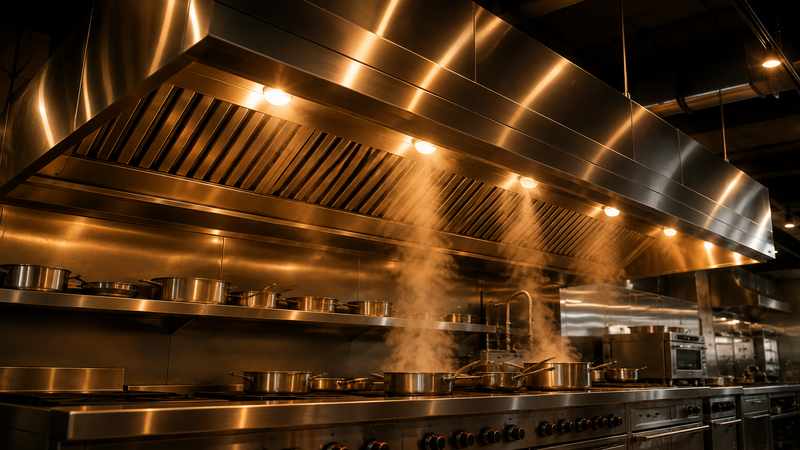
Commercial Kitchen Ventilation Systems Guide Leave a comment

A commercial kitchen generates intense heat, smoke, steam, grease particles, airborne contaminants, and cooking odors every minute it operates. Without a properly engineered ventilation system, even the most advanced commercial kitchen can quickly become uncomfortable, unsafe, and inefficient.
Whether you’re operating a restaurant, hotel, café, bakery, cloud kitchen, catering facility, or central production kitchen, investing in professional commercial kitchen ventilation systems is essential for maintaining operational efficiency, food safety, employee comfort, and equipment longevity.
Ventilation is not simply about removing hot air.
A professionally designed system creates a balanced environment where fresh air enters the kitchen while heat, smoke, grease, moisture, and airborne contaminants are safely extracted.
Whether you’re opening a restaurant in Downtown Dubai, building a café in Dubai Marina, launching a cloud kitchen in Al Quoz, developing a hospitality project in Abu Dhabi, or expanding operations across Sharjah, Ajman, Ras Al Khaimah, Fujairah, Al Ain, or Umm Al Quwain, ventilation planning should be one of the first engineering priorities.
At Horeca Hut, ventilation is treated as a critical component of every commercial kitchen project. Instead of viewing exhaust systems as standalone installations, Horeca Hut integrates ventilation into the complete kitchen design to improve workflow, equipment performance, energy efficiency, and long-term operational reliability.
Why Commercial Kitchen Ventilation Is Essential
Many restaurant owners focus heavily on cooking equipment while underestimating the importance of ventilation.
However, every piece of cooking equipment continuously produces:
- Heat
- Steam
- Smoke
- Grease vapor
- Moisture
- Odors
- Combustion gases
Without effective ventilation, these byproducts accumulate rapidly.
This creates uncomfortable working conditions while increasing operational risks.
For hood selection specifically, see our Restaurant Kitchen Exhaust Hood buying guide, and for how ventilation fits into the wider design process, review our Commercial Kitchen Layout Design guide. As one of the trusted Horeca Suppliers UAE, Horeca Hut designs complete ventilation systems for every kitchen type.
Benefits of Professional Restaurant Ventilation
A properly engineered ventilation system helps restaurants:
- Improve indoor air quality
- Reduce kitchen temperature
- Remove smoke efficiently
- Capture grease particles
- Improve employee comfort
- Enhance food safety
- Protect kitchen equipment
- Lower cleaning requirements
- Support energy efficiency
- Extend equipment lifespan
These benefits become increasingly important in the UAE’s hot climate.
Understanding Commercial Kitchen Ventilation Systems
Commercial kitchen ventilation involves much more than installing an exhaust fan.
A complete ventilation system consists of multiple integrated components working together.
Typical systems include:
- Exhaust hoods
- Ductwork
- Exhaust fans
- Fresh air supply
- Make-up air systems
- Grease filtration
- Fire safety integration
- Air balancing controls
Each component contributes to maintaining proper airflow throughout the kitchen.
How Commercial Kitchen Ventilation Works
Professional ventilation systems continuously remove contaminated air while replacing it with clean outside air.
The process generally follows this sequence:
- Cooking equipment generates heat and grease.
- Exhaust hoods capture airborne contaminants.
- Grease filters remove grease particles.
- Duct systems transport contaminated air.
- Exhaust fans discharge air outside.
- Fresh air systems replace extracted air.
- Air pressure remains balanced throughout the kitchen.
This continuous cycle maintains a comfortable and productive working environment.
Main Components of Commercial Kitchen Ventilation Systems
Commercial Exhaust Hoods
The exhaust hood is the primary collection point above cooking equipment.
It captures:
- Smoke
- Steam
- Heat
- Grease vapor
- Cooking odors
Proper hood sizing directly affects system performance.
Kitchen Exhaust Ductwork
Duct systems transport contaminated air safely outside the building.
Professional duct design focuses on:
- Efficient airflow
- Grease management
- Easy maintenance
- Fire safety
- Pressure control
Poor duct design reduces ventilation efficiency.
Exhaust Fans
Exhaust fans generate the airflow required to remove contaminated air.
Fan selection depends on:
- Kitchen size
- Cooking equipment
- Air volume
- Heat production
- Building configuration
Proper sizing ensures stable system performance.
Make-Up Air Systems
Every cubic meter of exhausted air must be replaced.
Fresh air systems supply clean outside air back into the kitchen.
Without make-up air:
- Air pressure becomes unstable.
- Doors become difficult to open.
- Exhaust efficiency decreases.
- Employee comfort declines.
Balanced airflow is critical.
Grease Filters
Grease filters prevent grease from entering ductwork.
Benefits include:
- Cleaner ducts
- Reduced fire risk
- Easier maintenance
- Better airflow
Regular cleaning maintains performance.
Types of Restaurant Ventilation Systems
Different commercial kitchens require different ventilation strategies.
Wall-Mounted Hood Systems
Suitable for equipment positioned against walls.
Common applications:
- Restaurants
- Cafés
- Hotels
Island Hood Systems
Designed for centrally positioned cooking lines.
Frequently used in:
- Hotel kitchens
- Open kitchens
- Large restaurants
Condensate Hoods
Designed primarily for steam-producing equipment.
Commonly used with:
- Combination ovens
- Dishwashers
- Steamers
Fresh Air Systems
Supply conditioned replacement air.
Benefits include:
- Comfortable working temperatures
- Balanced air pressure
- Improved ventilation performance
Kitchen Exhaust Systems UAE Requirements

Restaurants operating throughout Dubai and the UAE experience unique environmental conditions.
High outdoor temperatures increase the importance of efficient ventilation.
Professional kitchen exhaust systems help businesses:
- Improve employee comfort
- Maintain cooking performance
- Reduce heat buildup
- Protect refrigeration equipment
- Lower utility costs
Well-designed systems improve the overall kitchen environment.
Ventilation Planning During Kitchen Design
Ventilation should never be added after equipment installation.
Instead, it should be integrated during the earliest planning stages.
Professional planners evaluate:
- Cooking equipment
- Heat generation
- Ceiling height
- Kitchen size
- Airflow requirements
- Building structure
- Utility routing
Early planning reduces future modifications.
Common Restaurant Equipment Requiring Ventilation
The following equipment typically requires exhaust integration:
- Cooking ranges
- Fryers
- Charbroilers
- Griddles
- Combination ovens
- Salamanders
- Woks
- Tilting pans
Each appliance contributes differently to airflow requirements.
Benefits of Proper Kitchen Airflow
Good airflow improves:
- Employee productivity
- Kitchen temperature
- Equipment performance
- Air quality
- Customer comfort
- Cleaning efficiency
- Food safety
- Utility efficiency
Professional airflow planning directly influences restaurant profitability.
Common Ventilation Planning Mistakes
Restaurants often experience ventilation problems because of poor planning.
Typical mistakes include:
- Undersized exhaust hoods
- Poor duct routing
- Inadequate make-up air
- Incorrect fan sizing
- Delayed ventilation planning
- Poor equipment positioning
- Difficult maintenance access
Professional engineering prevents these issues.
Restaurant Ventilation Trends Across Dubai and the UAE
Hospitality businesses across Dubai, Abu Dhabi, Sharjah, Ajman, Ras Al Khaimah, Fujairah, Al Ain, and Umm Al Quwain increasingly invest in:
- Smart ventilation controls
- Energy-efficient exhaust systems
- Variable-speed fan technology
- Heat recovery systems
- Low-noise ventilation
- Sustainable airflow solutions
Modern ventilation systems improve both operational efficiency and sustainability.
Commercial Kitchen Ventilation Design Best Practices
A high-performance commercial kitchen ventilation system is not determined by the size of the exhaust fan alone. Instead, it depends on how every component works together to maintain balanced airflow throughout the kitchen.
Professional commercial kitchen ventilation systems are designed around operational requirements, cooking equipment, kitchen layout, and production capacity.
Every restaurant, hotel, café, bakery, catering kitchen, and cloud kitchen requires a customized ventilation strategy rather than a one-size-fits-all solution.
Start Ventilation Planning Before Construction
One of the most common mistakes is treating ventilation as the final stage of a project.
Professional kitchen planners integrate ventilation into the kitchen layout from the very beginning.
This allows designers to coordinate:
- Cooking equipment placement
- Exhaust hood positioning
- Duct routing
- Utility infrastructure
- Ceiling clearances
- Fresh air supply
- Fire protection systems
Early planning reduces installation challenges and avoids expensive redesigns.
Balance Exhaust Air and Fresh Air
An efficient commercial kitchen should never only remove air.
Every cubic meter of exhausted air should be replaced with fresh make-up air.
Balanced airflow helps maintain:
- Stable kitchen temperatures
- Comfortable working conditions
- Proper air pressure
- Efficient exhaust performance
- Better indoor air quality
Without adequate replacement air, even powerful exhaust systems become inefficient.
Design Around Cooking Equipment

Different cooking appliances generate different amounts of heat, grease, and smoke.
Ventilation requirements should always be based on the cooking line rather than kitchen size alone.
High-demand equipment typically includes:
- Fryers
- Charbroilers
- Charcoal grills
- Wok ranges
- Heavy-duty ranges
- Combination ovens
- Rotisserie ovens
Each appliance influences hood size, exhaust volume, and airflow requirements.
Ensure Easy Maintenance Access
Ventilation systems require regular inspection and cleaning.
Professional designs include adequate access to:
- Exhaust hoods
- Grease filters
- Ductwork
- Fan motors
- Fire suppression interfaces
Maintenance-friendly systems reduce downtime and improve long-term performance.
Fire Safety and Grease Management
Cooking operations continuously produce grease vapors that accumulate inside exhaust systems.
Without proper management, grease buildup may reduce airflow efficiency and increase maintenance requirements.
Professional ventilation design helps minimize these risks through:
- Proper hood sizing
- Effective grease filtration
- Accessible ductwork
- Routine servicing
- Balanced airflow
Restaurants that invest in professional ventilation planning generally experience cleaner and more reliable exhaust systems.
The Importance of Air Quality in Commercial Kitchens
Kitchen air quality directly affects both employees and operations.
Poor ventilation often results in:
- High indoor temperatures
- Smoke accumulation
- Excess humidity
- Grease particles in the air
- Strong cooking odors
These conditions reduce productivity and create an uncomfortable working environment.
Professional ventilation systems improve:
- Staff comfort
- Equipment performance
- Indoor air quality
- Operational efficiency
- Customer experience in open-kitchen concepts
Ventilation and Energy Efficiency
Many restaurant owners assume ventilation always increases energy costs.
In reality, properly engineered ventilation systems often improve overall energy efficiency.
Professional airflow management helps:
- Reduce cooling loads
- Improve equipment efficiency
- Lower kitchen temperatures
- Reduce refrigeration stress
- Improve HVAC performance
Modern commercial kitchens increasingly combine energy-efficient cooking equipment with optimized ventilation systems to reduce long-term operating costs.
Maintaining Kitchen Exhaust Systems UAE
Even the best ventilation systems require regular maintenance.
Routine servicing ensures consistent airflow while protecting equipment performance.
Recommended Maintenance Activities
Professional maintenance programs typically include:
- Hood cleaning
- Grease filter inspection
- Exhaust fan servicing
- Duct inspection
- Airflow testing
- Motor maintenance
- System performance evaluation
Routine maintenance extends equipment lifespan and supports reliable kitchen operations.
Warning Signs Your Ventilation System Needs Attention
Restaurant operators should monitor ventilation performance regularly.
Common warning signs include:
- Excess kitchen heat
- Persistent smoke
- Grease buildup around equipment
- Unusual fan noise
- Reduced airflow
- Lingering cooking odors
- Increased humidity
Addressing these issues early helps prevent more significant operational problems.
Common Commercial Kitchen Ventilation Mistakes
Many ventilation issues originate during the design phase rather than after installation.
Understanding these mistakes helps businesses avoid costly corrections.
Installing an Undersized Exhaust System
An undersized exhaust system struggles to remove heat and smoke during peak production.
Proper system sizing should always match the cooking equipment and production volume.
Ignoring Future Expansion
Many restaurants add new cooking equipment after opening.
Ventilation systems should be designed with sufficient capacity to support future growth whenever possible.
Poor Hood Placement
Incorrect hood positioning reduces grease capture efficiency and affects overall airflow.
Professional installation ensures every cooking appliance receives proper coverage.
Inadequate Fresh Air Supply
Removing air without replacing it creates pressure imbalance.
Balanced make-up air systems are essential for stable ventilation performance.
Delaying Ventilation Planning
Ventilation should never be considered after equipment installation.
It must be incorporated into the commercial kitchen design from the earliest planning stages.
Commercial Kitchen Ventilation Trends in the UAE
The hospitality industry across Dubai, Abu Dhabi, Sharjah, Ajman, Ras Al Khaimah, Fujairah, Al Ain, and Umm Al Quwain continues investing in smarter ventilation technologies.
Current industry trends include:
- Variable-speed exhaust systems
- Smart airflow monitoring
- Energy-efficient fan systems
- Low-noise ventilation solutions
- Heat recovery technologies
- Integrated building management systems
- Sustainable commercial kitchen engineering
These technologies help restaurants improve efficiency while reducing operating costs.
Why Horeca Hut Is the Ideal Partner for Commercial Kitchen Ventilation Systems
Designing an effective commercial kitchen ventilation system requires more than selecting exhaust hoods and fans.
Successful ventilation integrates engineering expertise, airflow analysis, commercial kitchen planning, equipment coordination, and hospitality experience.
This is exactly where Horeca Hut delivers exceptional value.
Rather than supplying ventilation components independently, Horeca Hut develops complete commercial kitchen environments where ventilation works seamlessly alongside cooking equipment, refrigeration systems, workflow planning, and utility infrastructure.
Horeca Hut provides comprehensive solutions including:
- Commercial kitchen ventilation systems
- Kitchen exhaust systems UAE
- Restaurant ventilation planning
- Commercial exhaust hood design
- Airflow engineering
- Kitchen layout planning
- Utility coordination
- Commercial kitchen equipment supply
- Professional installation
- Preventive maintenance and technical support
Whether developing a luxury restaurant in Downtown Dubai, opening a café in Dubai Marina, building a cloud kitchen in Al Quoz, planning a hotel kitchen in Abu Dhabi, expanding a bakery in Sharjah, creating a catering facility in Ajman, developing a hospitality project in Ras Al Khaimah, investing in Fujairah, opening a restaurant in Al Ain, or operating anywhere across the UAE, Horeca Hut delivers ventilation solutions tailored to each project’s operational requirements.
Every Horeca Hut project begins with detailed consultation.
The engineering team evaluates:
- Restaurant concept
- Cooking equipment
- Heat generation
- Production volume
- Kitchen dimensions
- Ceiling configuration
- Airflow requirements
- Utility infrastructure
- Future expansion plans
Only after understanding the complete operational environment does Horeca Hut design the ventilation solution.
This consultative methodology ensures commercial kitchens achieve:
- Better air quality
- Improved employee comfort
- Faster production
- Enhanced food safety
- Greater energy efficiency
- Longer equipment lifespan
- Lower operating costs
Rather than acting solely as an equipment supplier, Horeca Hut becomes a long-term hospitality engineering partner, supporting projects from concept and design through installation, commissioning, maintenance, and future expansion.
Conclusion
Professional commercial kitchen ventilation systems are among the most important investments for any hospitality business.
An effective ventilation system protects employees, improves kitchen performance, supports food safety, enhances equipment efficiency, and creates a more productive working environment.
Whether operating restaurants, hotels, cafés, bakeries, cloud kitchens, or catering facilities across Dubai, Abu Dhabi, Sharjah, Ajman, Ras Al Khaimah, Fujairah, Al Ain, or Umm Al Quwain, investing in professionally engineered kitchen exhaust systems UAE businesses trust provides measurable operational benefits.
By partnering with Horeca Hut, hospitality operators gain access to complete commercial kitchen ventilation solutions backed by engineering expertise, premium equipment, technical consultation, installation excellence, and long-term operational support—ensuring every kitchen remains efficient, comfortable, and prepared for sustainable growth.
Frequently Asked Questions
What are commercial kitchen ventilation systems?
Commercial kitchen ventilation systems remove heat, smoke, grease, steam, and cooking odors while supplying fresh air to maintain a safe and comfortable working environment.
Why is restaurant ventilation important?
Restaurant ventilation improves air quality, protects staff, enhances food safety, supports equipment performance, and helps maintain efficient kitchen operations.
What is a kitchen exhaust system?
A kitchen exhaust system consists of exhaust hoods, ductwork, fans, grease filters, and related components that remove contaminated air from commercial kitchens.
How do commercial kitchen ventilation systems work?
They capture smoke and grease above cooking equipment, transport contaminated air through ductwork, exhaust it outside, and replace it with fresh make-up air.
Which kitchen equipment requires ventilation?
Equipment such as fryers, grills, ranges, charbroilers, wok stations, combination ovens, and salamanders typically require properly designed exhaust systems.
How often should kitchen ventilation systems be maintained?
Commercial kitchen ventilation systems should be inspected and serviced regularly to maintain airflow efficiency and reliable operation.
What are common ventilation design mistakes?
Common mistakes include undersized exhaust systems, poor hood placement, inadequate fresh air supply, delayed planning, and insufficient maintenance access.
Can proper ventilation improve energy efficiency?
Yes. Well-designed ventilation systems help reduce cooling loads, improve HVAC performance, and support more efficient commercial kitchen operations.
Who needs professional commercial kitchen ventilation?
Restaurants, cafés, hotels, bakeries, catering companies, cloud kitchens, hospitals, schools, and institutional kitchens all benefit from professionally engineered ventilation systems.
Why choose Horeca Hut for commercial kitchen ventilation?
Horeca Hut provides complete ventilation solutions, including airflow engineering, exhaust system design, kitchen planning, equipment integration, installation, commissioning, and long-term technical support for hospitality businesses across the UAE.