















Picture this: You are standing in the middle of a busy kitchen at lunch peak. Your sous chef needs to pull proteins for fifteen simultaneous orders. Your pastry chef needs cream and butter from a different corner of the kitchen. Your bar team needs mixers and garnishes from yet another location. Every second of delay costs you money, customer satisfaction, and team morale. The decision you made months earlier — choosing between a walk-in freezer vs reach-in refrigerator — is now playing out in real time, and the wrong choice is painfully obvious.
The debate between a walk-in freezer vs reach-in refrigerator is one of the most important equipment decisions any restaurant owner, café operator, or foodservice manager will make. And yet it is one that is frequently made hastily, based on incomplete information, or simply on what seemed like the best deal at the time. The consequences of getting it wrong — wasted space, inadequate storage, energy waste, food safety risks — can follow a business for years.
This comprehensive guide explores every dimension of the walk-in freezer vs reach-in refrigerator decision: what each unit does best, how they compare on cost, space, energy efficiency, and suitability for different types of operations, and how to make the right choice for your specific restaurant or café — especially in the unique context of the UAE’s demanding restaurant refrigeration options landscape.
Walk-In Freezer vs Reach-In Refrigerator: Understanding the Basics
Before diving into the detailed comparison, it is essential to understand precisely what each type of unit is and how it fundamentally differs from the other.
What Is a Walk-In Freezer?
A walk-in freezer is a large, room-sized refrigerated storage space that personnel can physically enter. It is built as part of the kitchen infrastructure — either as a modular panel system assembled on-site or as a permanent structure — and can range in size from a small 2m × 2m unit to enormous warehouse-scale installations. Walk-in freezers maintain temperatures between -18°C and -25°C, making them suitable for long-term storage of frozen products, bulk proteins, pre-made items, and ice cream.
In the walk-in cooler UAE market, these units are typically installed during kitchen construction or renovation, as their size and infrastructure requirements make post-construction installation complex and costly. They represent a significant capital investment but offer unparalleled storage capacity for high-volume operations.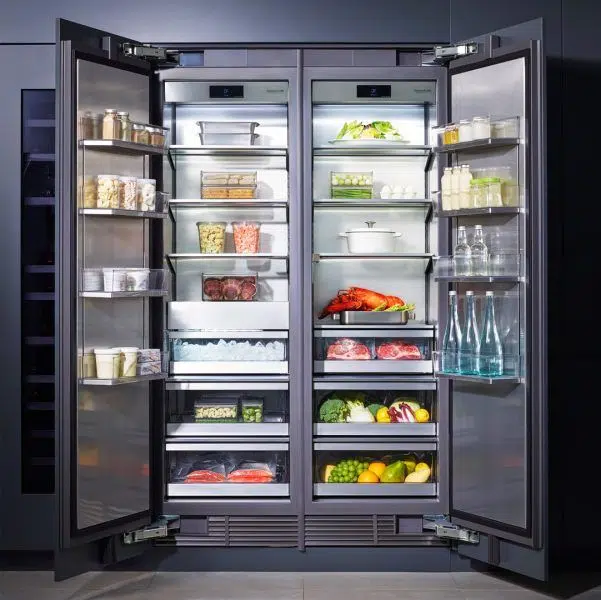
What Is a Reach-In Refrigerator?
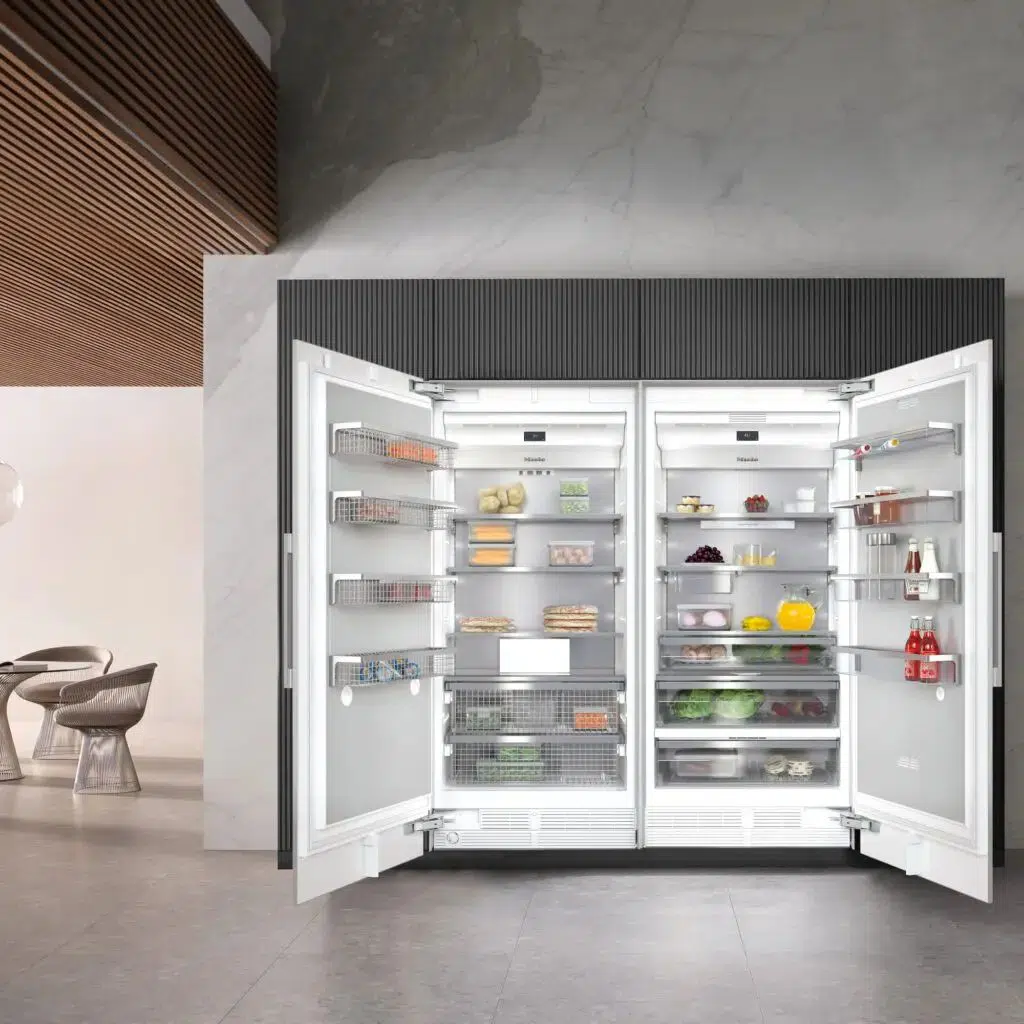
A reach-in refrigerator (or freezer) is a freestanding upright cabinet — typically one, two, or three doors wide — that sits on the kitchen floor. Staff reach into the unit to retrieve items rather than walking inside. Reach-in refrigerators maintain temperatures between 0°C and 4°C; reach-in freezers operate between -18°C and -22°C. They are the most widely used type of refrigeration in commercial kitchens worldwide due to their versatility, accessible sizing, and relatively modest footprint.
According to this reach-in refrigerator guide, these units shine in daily-use scenarios: prep stations, cooking lines, bar areas, and anywhere frequent access to refrigerated products is required. They are available in a vast range of sizes — from compact undercounter models to full-height, three-section cabinets — making them adaptable to virtually any kitchen layout.
read more : Commercial Refrigeration Equipment Guide for Restaurants & Cafés
Walk-In Freezer vs Reach-In Refrigerator: The Core Differences at a Glance
When evaluating the walk-in freezer vs reach-in refrigerator decision, the following comparison table provides a structured overview of how the two options differ across the most important dimensions:
| Feature | Walk-In Freezer/Cooler | Reach-In Refrigerator/Freezer |
| Storage Capacity | Very High (unlimited scalable) | Low to Medium |
| Space Required | Large (entire room footprint) | Small to Moderate |
| Installation | Complex; requires construction | Simple; plug-and-play |
| Upfront Cost (AED) | AED 15,000–100,000+ | AED 2,000–15,000 |
| Energy Consumption | High (but efficient per litre) | Low to Moderate |
| Access Speed | Slower (walk-in required) | Fast (immediate access) |
| Best For | Bulk/long-term storage | Daily use & quick access |
| Temperature Stability | Excellent (large thermal mass) | Good (smaller mass) |
| Flexibility/Relocation | Very Low (fixed structure) | High (moveable) |
| Organisation Options | Extensive shelving systems | Standard shelf configuration |
| UAE Climate Suitability | Requires tropicalized design | Choose tropicalized models |
When a Walk-In Freezer Is the Right Choice for Your Restaurant
Understanding when a walk-in freezer vs reach-in refrigerator decision tips decisively in favor of the walk-in is critical for operators planning their kitchen layout. Walk-in units win on several key dimensions:
High-Volume Operations with Bulk Storage Needs
Any restaurant or hotel kitchen processing more than 200 covers per service will almost certainly require walk-in storage capacity. When you are receiving deliveries of hundreds of kilograms of proteins, mountains of fresh produce, and vast quantities of dairy products several times per week, no configuration of reach-in units can provide the organized, scalable storage that a walk-in offers.
In the UAE’s hotel sector — where a single property might serve thousands of covers across multiple outlets daily — the walk-in cooler UAE is not a luxury but an absolute operational necessity. Large catering companies, hospital kitchens, and school meal production facilities fall into the same category.
Operations with Infrequent Delivery Schedules
If your restaurant or café is located in a remote area of the UAE, a hotel property, or any location where daily deliveries are impractical, a walk-in allows you to receive larger quantities of perishables less frequently. This reduces delivery costs, simplifies supply chain management, and ensures you have reserves during periods of supply disruption.
Large-Format Product Storage Requirements
Some products simply cannot be stored in reach-in units. Whole carcasses and primal cuts of meat, full hotel pans loaded with prepared dishes, large buffet platters, and industrial-size containers all require the physical space that only a walk-in can provide. In the context of commercial freezer comparison, this is one of the clearest differentiators: walk-ins simply accommodate formats and quantities that reach-ins cannot.
Centralized Production and Cook-Chill Operations
Central production kitchens — those that prepare food in large batches for distribution to multiple outlets — depend on walk-in storage as the core of their refrigeration infrastructure. Similarly, cook-chill operations, where food is cooked in bulk and rapidly chilled for later service, require walk-in capacity to store the chilled product before reheating and service.
🛒 Shop Professional Food Storage Containers — HorecaHut UAE
When a Reach-In Refrigerator Is the Better Choice
The walk-in freezer vs reach-in refrigerator debate does not always favor the walk-in. In many real-world restaurant and café scenarios, reach-in units are the superior choice or the only practical option.
Small to Medium-Sized Restaurants and Cafés
For a 30–80 cover restaurant, a well-configured set of reach-in units — perhaps one or two refrigerators and a freezer — will typically meet all storage needs while leaving the kitchen footprint free for productive workspace. The capital that would be spent on a walk-in installation can instead be invested in kitchen equipment, staff training, or marketing.
Many highly successful independent restaurants in Dubai, Abu Dhabi, and across the UAE operate with exclusively reach-in restaurant refrigeration options, supplemented by excellent supply chain relationships that ensure daily or twice-daily deliveries of fresh product. This model keeps inventory lean, reduces waste, and ensures maximum freshness.
Kitchens with Limited Space Availability
Urban restaurant properties in Dubai and Abu Dhabi are expensive, and every square meter of kitchen space represents a significant cost. A walk-in installation can occupy 6–12 square meters or more — space that might be far more valuable as prep area, cooking line, or additional seating. In tight urban kitchen layouts, reach-in units offer far better space efficiency, especially when undercounter models are incorporated beneath existing worktops.
Operations Requiring High-Frequency Access
In a fast-paced kitchen, seconds matter. Reach-in units positioned strategically along the cooking line allow chefs to access ingredients in seconds without interrupting their workflow. In busy service periods, the reach-in refrigerator guide principle applies: have what you need where you need it, right now. Walk-ins, by contrast, require a dedicated trip to a separate area of the kitchen — impractical during intense service periods.
Start-Up Operations and Budget Constraints
New restaurant openings carry enormous upfront costs. For start-up operators, the capital investment required for a walk-in installation — including construction, insulated panels, refrigeration systems, shelving, and professional installation — can be prohibitive. Quality reach-in units from tropicalized brands offer reliable restaurant refrigeration options at a fraction of the cost, allowing operators to scale up to a walk-in as the business grows and generates the cash flow to support the investment.
🛒 Shop GN Containers for Commercial Kitchens — HorecaHut UAE
Walk-In Freezer vs Reach-In Refrigerator: Detailed Cost Analysis
Cost is inevitably one of the primary drivers in the walk-in freezer vs reach-in refrigerator decision. However, a simplistic price comparison misses the full picture. Here is a comprehensive cost analysis across all relevant dimensions:
Upfront Capital Cost
A walk-in cooler or freezer in the UAE typically costs between AED 15,000 and AED 100,000+ depending on size, specification, and installation complexity. This includes insulated panels, the refrigeration unit (condensing unit and evaporator coil), shelving, door hardware, flooring, and professional installation. Custom sizes or remote condensing unit configurations increase costs further.
By contrast, a quality commercial freezer comparison between reach-in options reveals pricing ranging from AED 2,000–3,000 for a basic single-door unit to AED 10,000–15,000 for a high-specification three-door tropicalized model. Multiple units can be purchased and placed strategically for significantly less than a single walk-in installation.
Operating Costs and Energy Consumption
Walk-in units consume significantly more electricity than individual reach-in units due to their size. However, on a per-litre-of-storage basis, they are often more efficient. A well-insulated walk-in of 10 cubic meters typically uses 15–25 kWh per day. Three reach-in refrigerators might use 8–15 kWh per day combined but provide only 2–3 cubic meters of storage. For large volumes, the walk-in’s cost-per-litre efficiency becomes compelling.
Maintenance and Repair Costs
Walk-in refrigeration systems are more complex and more expensive to service than reach-in units. A refrigeration engineer call-out for a walk-in system repair can cost AED 500–2,000+ depending on the fault, with compressor replacements potentially reaching AED 5,000–15,000. Reach-in unit repairs are generally less complex and less costly. However, in the walk-in cooler UAE market, walk-in systems are also typically more durable and require less frequent major intervention when properly maintained.
Lost Revenue Risk (Downtime Cost)
This is perhaps the most underappreciated cost factor in the walk-in freezer vs reach-in refrigerator comparison. If a reach-in unit fails, you lose 15–30% of your refrigeration capacity. If your single walk-in fails, you may lose 80–100% of your cold storage overnight, resulting in thousands of dirhams of spoiled product and potential closure of the kitchen until repairs are completed. Redundancy — having multiple reach-in units — provides inherent resilience that a single walk-in cannot match.
The Hybrid Approach: Walk-In Plus Reach-In for Optimal Restaurant Refrigeration
For many restaurant and café operations, the walk-in freezer vs reach-in refrigerator debate resolves not with a binary choice but with a hybrid strategy that combines both types. This is, in fact, the most common configuration in well-designed commercial kitchens worldwide — and it represents the gold standard in restaurant refrigeration options planning.
How the Hybrid Strategy Works
In a hybrid configuration, the walk-in cooler or freezer serves as the bulk storage backbone — the ‘warehouse’ — where weekly deliveries are stored and organized. Each morning (or several times per day in very busy operations), the kitchen team transfers a day’s supply of ingredients from the walk-in to reach-in units and undercounter fridges positioned along the cooking line and prep areas.
This approach delivers the best of both worlds: the capacity of a walk-in, combined with the accessibility and workflow efficiency of reach-ins. The day’s supply in the reach-in units can be accessed in seconds during service, while the walk-in’s thermal mass maintains consistent temperatures despite multiple brief openings throughout the day.
Recommended Hybrid Configurations by Restaurant Type
- 50–100 cover restaurant: 1 walk-in cooler + 1 walk-in freezer + 2 reach-in refrigerators on the line + 1 undercounter unit
- 100–200 cover restaurant: 1–2 walk-in coolers + 1 walk-in freezer + 3–4 reach-in refrigerators + 2 prep tables + undercounter units
- Hotel kitchen (200+ covers across multiple outlets): Multiple walk-in coolers and freezers + reach-ins in each kitchen section + blast chiller
- Small café (20–40 covers): 2 reach-in refrigerators + 1 reach-in freezer + 1 undercounter unit — likely no walk-in needed
📷 [Suggested Image: walk-in freezer vs reach-in refrigerator — hybrid kitchen refrigeration layout diagram]
🛒 Browse Kitchen Appliances for Restaurants — HorecaHut UAE
Walk-In Cooler UAE: Special Considerations for the Gulf Climate
The UAE’s climate creates specific challenges and considerations for both sides of the walk-in freezer vs reach-in refrigerator equation. Understanding these will help you make a decision that performs reliably in the UAE’s unique environment.
Walk-In Insulation Requirements in the UAE
In the walk-in cooler UAE context, insulation specification is critical. Standard walk-in panel insulation of 80mm PU (polyurethane) foam may be sufficient in temperate climates but is often recommended to be upgraded to 100mm or 120mm for UAE installations. Thicker insulation reduces the thermal load on the refrigeration system, lowers energy consumption, and improves temperature stability during peak ambient temperature conditions.
Condensing Unit Placement for Walk-In Units
In the UAE, placement of the condensing unit is a major design decision. Locating the condenser in a poorly ventilated, hot utility room — as is common in many UAE kitchens — can reduce efficiency by 20–30% and dramatically shorten compressor life. Remote condensers located on rooftops in shaded, well-ventilated positions, or in air-conditioned spaces, will outperform poorly placed internal units in the UAE’s hot climate significantly.
Reach-In Tropicalization for the UAE Market
For reach-in units in the UAE, Climate Class T rating (up to 43°C ambient) is the absolute minimum requirement for reliable operation. The reach-in refrigerator guide for UAE buyers should focus specifically on brands that publish and guarantee their Climate Class T performance — brands like Hoshizaki, Williams, True, and Electrolux Professional, all of which have UAE-specific models or tropicalized versions of their standard ranges.
Door Discipline and Training
In the UAE’s hot climate, every second a walk-in or reach-in door is open allows warm, humid air to flood the unit — increasing condensation, ice buildup, and compressor workload. Staff training on door discipline (close promptly, do not prop doors open, use door curtains or strip curtains on walk-ins) is an essential operational practice for any commercial freezer comparison or procurement decision to translate into real-world performance.
🛒 Shop Professional Kitchen Accessories — HorecaHut UAE
How to Decide: Walk-In Freezer vs Reach-In Refrigerator — A Step-by-Step Decision Framework
Use this structured decision framework to determine the right walk-in freezer vs reach-in refrigerator configuration for your specific operation:
- Step 1 — Calculate your daily ingredient volume. Add up the total weight and volume of perishable ingredients you use in an average day. If your daily use exceeds 100 kg or 500 litres of refrigerated/frozen product, a walk-in is almost certainly necessary.
- Step 2 — Assess your delivery frequency. If you receive daily or twice-daily deliveries, you can manage with less storage capacity (reach-ins may suffice). If deliveries are 2–3 times per week, you need significantly more storage, which generally means a walk-in.
- Step 3 — Map your available kitchen footprint. Determine whether you have at least 4–6 square meters of floor space that can be dedicated to walk-in installation, plus adequate clearance for condensing equipment. If not, reach-in units are the practical choice.
- Step 4 — Evaluate your budget for capital investment. Walk-ins require AED 15,000–100,000+ upfront. If your launch budget cannot accommodate this, quality reach-ins at AED 2,000–15,000 each can serve you well initially.
- Step 5 — Consider your product mix. Do you need to store large-format items, whole carcasses, or full-sheet trays? If yes, a walk-in is likely non-negotiable. If your products fit within standard reach-in shelf configurations, reach-ins may serve you fully.
- Step 6 — Think about future scaling. If you plan to grow your covers significantly or expand your menu, factor in future refrigeration needs. It is often more cost-effective to install a walk-in during the initial kitchen build than to retrofit one later.
- Step 7 — Factor in UAE climate requirements. Whichever type you choose, verify that the unit is tropicalized for the UAE’s extreme ambient temperatures. This applies equally to walk-in cooler UAE specifications and reach-in refrigerator guide recommendations.

Frequently Asked Questions: Walk-In Freezer vs Reach-In Refrigerator
Q1: Which is better for a small restaurant: walk-in or reach-in refrigeration?
For small restaurants under 80 covers with daily delivery access, reach-in refrigerators and freezers are typically the better choice. They are more cost-effective, require less space, and provide sufficient storage for lean, daily-use inventory models. The walk-in freezer vs reach-in refrigerator decision tips toward walk-in only when volume, delivery schedule, or product format requirements cannot be met by reach-ins.
Q2: How much does a walk-in cooler cost in the UAE?
A walk-in cooler UAE installation typically costs between AED 15,000 for a small modular unit and AED 80,000–100,000+ for a large, custom-built installation. Costs include insulated panels, refrigeration equipment, shelving, flooring, door hardware, electrical work, and professional installation. Remote condenser configurations and walk-in freezer specifications (requiring more powerful refrigeration systems) increase costs further.
Q3: Can I use multiple reach-in units instead of a walk-in?
Yes, in many operations multiple reach-in units provide a practical and cost-effective alternative to a walk-in. The advantage of this restaurant refrigeration options approach is built-in redundancy — if one unit fails, the others continue operating. The disadvantage is less total storage capacity and higher energy costs per litre of storage at very high volumes. For operations up to approximately 150 covers, multiple reach-ins often provide a viable alternative to a walk-in.
Q4: What is the temperature difference between a walk-in cooler and a walk-in freezer?
A walk-in cooler maintains temperatures between 0°C and 4°C, used for fresh produce, dairy, cooked foods, and other perishables requiring refrigeration but not freezing. A walk-in freezer maintains temperatures between -18°C and -25°C, used for frozen proteins, ice cream, pre-made frozen items, and long-term storage. The same commercial freezer comparison applies to reach-in units: reach-in refrigerators operate in the 0°C–4°C range; reach-in freezers operate at -18°C or below.
Q5: How much space does a walk-in cooler require in a commercial kitchen?
A small walk-in cooler suitable for a mid-size restaurant requires a minimum floor footprint of approximately 2m × 2.4m (just under 5 square meters), plus additional clearance around the perimeter for airflow and access. Larger operations will require proportionally more space. Before committing to a walk-in cooler UAE installation, always have a qualified refrigeration engineer assess the space requirements for your specific kitchen layout and product volume.
Q6: Are reach-in refrigerators energy efficient?
Modern, quality reach-in refrigerators with inverter compressors, LED lighting, and well-sealed doors are highly energy efficient for their storage capacity. In the UAE context, tropicalized models are specifically engineered to maintain efficiency in high ambient temperatures. Per-unit energy consumption ranges from approximately 3–8 kWh per day for a standard two-door reach-in, depending on the specification, ambient conditions, and door-opening frequency.
Q7: What maintenance does a walk-in cooler need in the UAE?
For walk-in cooler UAE operations, quarterly professional servicing by a qualified refrigeration engineer is strongly recommended. This includes cleaning condenser and evaporator coils (monthly in dusty environments), checking refrigerant levels and leak testing, inspecting door seals and strip curtains, clearing drain lines, and verifying temperature controller calibration. The UAE’s dusty environment means coil cleaning is particularly important — blocked condensers in a hot climate are a leading cause of walk-in system failure.
Q8: How do I know if my restaurant needs a walk-in or a reach-in?
Apply the walk-in freezer vs reach-in refrigerator decision framework outlined earlier in this guide: evaluate your cover count, daily ingredient volume, delivery frequency, kitchen footprint, budget, and future growth plans. If your daily refrigerated ingredient use exceeds 100 kg, you receive deliveries only 2–3 times per week, or you need to store large-format items, a walk-in is likely the right choice. For smaller, more agile operations with daily delivery access, reach-ins are usually sufficient.
Q9: Can a walk-in be converted between a cooler and a freezer?
Standard walk-in coolers cannot simply be converted to freezer operation — they require different insulation specifications (thicker panels), a more powerful refrigeration system, specific flooring to handle freeze-thaw cycles, and heated door frames to prevent icing. However, some manufacturers offer combination walk-in units with adjustable temperature zones, and specialized refrigeration engineers can convert a cooler to freezer use with significant investment in upgraded components. For commercial freezer comparison planning, it is far more practical to specify the correct unit type from the outset.
Q10: What are the best brands for reach-in refrigerators in the UAE?
For UAE applications, the reach-in refrigerator guide recommends prioritizing brands with proven tropical climate performance: Hoshizaki (Japanese engineering, exceptional quality), Williams Refrigeration (UK brand with Jade/Diamond tropical series), True Refrigeration (US brand with strong UAE track record), and Electrolux Professional/Zanussi Professional (comprehensive range with tropicalized models). Always verify Climate Class T rating for UAE kitchen environments before purchasing.
Q11: Is a walk-in cooler worth it for a café?
For most cafés, a walk-in cooler is not necessary and represents an over-investment. A typical café serving 30–80 covers with daily delivery of fresh ingredients can be fully served by two or three reach-in units plus an undercounter refrigerator. The exception is a high-volume café producing its own pastries, cakes, and food items in large quantities — in this case, a small walk-in may be justified. Always base the walk-in freezer vs reach-in refrigerator decision on your specific operational needs rather than aspirational capacity.
Q12: Where can I buy commercial refrigeration equipment in the UAE?
Commercial refrigeration equipment is available from specialist horeca equipment suppliers across the UAE. HorecaHut.ae offers a comprehensive selection of kitchen appliances and kitchen accessories for UAE foodservice businesses, with product specifications suited to the Gulf climate. For walk-in installations, work with certified refrigeration engineers who have experience designing systems for UAE ambient conditions.
🛒 Shop Best Kitchen Appliances in UAE — HorecaHut
Conclusion: Making the Right Walk-In Freezer vs Reach-In Refrigerator Decision
The walk-in freezer vs reach-in refrigerator decision is not a simple one, and there is no universally correct answer. What matters is that you make an informed choice based on your specific operation’s volume, space, budget, supply chain, product requirements, and growth trajectory — within the specific context of the UAE’s demanding climate and regulatory environment.
Walk-in coolers and freezers offer unbeatable capacity, organization, and long-term cost efficiency for high-volume operations. Reach-in refrigerators and freezers deliver accessibility, flexibility, cost-effectiveness, and resilience for small to medium operations, start-ups, and kitchen line environments. The smartest operators combine both — using walk-ins as their storage backbone and reach-ins as their operational workhorses.
Whatever configuration you choose, remember that in the walk-in cooler UAE market, climate performance is non-negotiable. Tropicalized specifications, proper installation, and rigorous maintenance are the foundations of reliable restaurant refrigeration options performance in the Gulf. Invest in quality, plan for growth, and build a cold chain that protects your food, your team, and your reputation.
We hope this guide has given you the clarity and confidence to make the right walk-in freezer vs reach-in refrigerator decision for your restaurant or café. If you found it valuable, please share it with fellow hospitality professionals, leave your questions and experiences in the comments, and explore our full range of professional kitchen equipment at HorecaHut.ae — your trusted horeca partner in the UAE.
🛒 Explore All Kitchen Equipment & Appliances — HorecaHut UAE


