









In the hospitality industry, speed and consistency are critical to delivering exceptional guest experiences. A hotel may invest heavily in premium kitchen equipment, talented chefs, and luxury dining concepts, yet still struggle with delays, bottlenecks, labor inefficiencies, and inconsistent service if workflow is poorly designed.
This is why hotel kitchen workflow optimization has become one of the most important aspects of modern hospitality operations.
A well-optimized kitchen workflow improves productivity, reduces wasted movement, increases service speed, enhances food quality, and creates a more efficient working environment for staff.
Whether managing a luxury resort kitchen, a five-star hotel banquet facility, a business hotel restaurant, or a large hospitality central kitchen, workflow optimization directly impacts operational performance and profitability.
For hotels, resorts, and hospitality businesses across Dubai, Abu Dhabi, Sharjah, Ajman, Ras Al Khaimah, Fujairah, Al Ain, and Umm Al Quwain, improving commercial kitchen workflow is no longer optional—it is a competitive necessity.
As a trusted horeca solutions provider in the UAE, Horeca Hut supports hospitality businesses with integrated kitchen planning, workflow optimization, equipment solutions, and operational consultancy designed to maximize kitchen efficiency.
Why Workflow Matters in Hotel Kitchens
Hotel kitchens operate under far more complex conditions than most standard restaurants.
Unlike single-outlet restaurants, hotel kitchens often serve multiple foodservice channels simultaneously.
These may include:
- All-day dining restaurants
- Fine dining outlets
- Room service
- Banquet halls
- Executive lounges
- Poolside cafés
- Breakfast buffets
- Staff cafeterias
- Bakery departments
Each service channel places different demands on the kitchen.
Without structured workflow, even well-equipped kitchens can become inefficient.
Common Workflow Challenges
Hotels frequently face issues such as:
- Congested work zones
- Delayed order execution
- Excess staff movement
- Cross-traffic between teams
- Slow dish return cycles
- Bottlenecks during peak periods
These issues directly affect service quality and labor efficiency.
Benefits of Workflow Optimization
A properly designed hotel kitchen workflow helps businesses:
- Improve service speed
- Increase productivity
- Reduce labor waste
- Improve food consistency
- Enhance staff coordination
- Support peak service demand
This is why workflow optimization is a major priority in hotel kitchen design.
Understanding Commercial Kitchen Workflow
Commercial kitchen workflow refers to the movement of:
- Ingredients
- Staff
- Equipment
- Cooked food
- Dirty dishes
through the kitchen during operations.
The goal is simple:
Create smooth movement with minimal friction.
Core Workflow Stages
Most hotel food service operations follow a sequence similar to:
- Receiving
- Storage
- Preparation
- Cooking
- Holding
- Service / Dispatch
- Dish Return
- Warewashing
Each stage should connect naturally to reduce delays and improve efficiency.
The Role of Hotel Kitchen Layout

Workflow and layout are deeply connected.
Even highly skilled teams struggle in poorly designed spaces.
A strong hotel kitchen layout minimizes unnecessary movement while maximizing accessibility.
Key Layout Objectives
An optimized layout should:
- Separate clean and dirty zones
- Reduce cross-traffic
- Improve workstation access
- Support safe movement
- Maximize equipment utilization
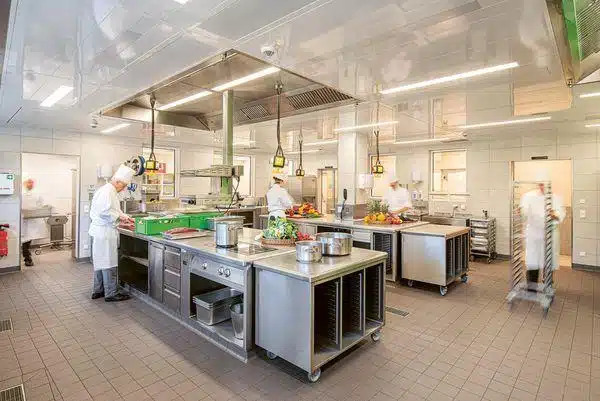
Common Hotel Kitchen Zones
Professional hotel kitchens typically include dedicated zones such as:
- Receiving area
- Dry storage
- Cold storage
- Preparation stations
- Hot kitchen
- Bakery / pastry section
- Holding area
- Dispatch zone
- Warewashing area
Each zone should be strategically positioned to support operational flow.
Receiving and Storage Workflow
The workflow begins before cooking.
Efficient receiving and storage systems reduce delays later in production.
Best Practices
Hotels should optimize:
- Delivery access
- Inspection zones
- Inventory intake
- Storage allocation
Poor receiving processes often create early bottlenecks.
Storage Optimization
Effective storage systems help improve:
- Inventory visibility
- Ingredient accessibility
- Stock rotation
- Preparation speed
This reduces wasted movement during service.
Preparation Zone Optimization

Preparation stations form the foundation of kitchen productivity.
Prep delays frequently create downstream bottlenecks.
Efficient Prep Stations Should Provide
- Easy ingredient access
- Adequate workspace
- Nearby refrigeration
- Proper tool organization
This allows staff to work faster and more consistently.
Cooking Line Efficiency

The cooking line is where workflow speed becomes most visible.
Peak service pressure often exposes layout weaknesses.
Common Cooking Line Bottlenecks
Examples include:
- Limited plating space
- Poor equipment placement
- Overcrowded workstations
- Shared equipment conflicts
Optimizing Cooking Stations
Hotels improve efficiency by organizing stations based on menu production flow.
Typical stations may include:
- Grill station
- Fry station
- Sauce station
- Hot pass
- Garnish area
Proper station design reduces delays and improves service timing.
Food Holding and Dispatch Workflow
After cooking, food must move efficiently toward service.
This stage becomes critical in banquet and room-service-heavy hotels.
Holding Equipment Improves Workflow
Professional holding systems help:
- Reduce service delays
- Maintain food temperature
- Improve order coordination
Common equipment includes:
- Holding cabinets
- Heated carts
- Pass-through warmers
These systems improve service consistency.
Warewashing Workflow Optimization

One of the most overlooked areas in hotel kitchen workflow optimization is warewashing.
Many hospitality businesses focus heavily on cooking efficiency while underestimating how dish return and cleaning directly affect kitchen performance.
Poor warewashing workflow often creates hidden bottlenecks.
Common Warewashing Challenges
Hotels frequently experience:
- Dirty dish accumulation
- Slow turnaround of utensils
- Congested cleaning zones
- Cross-traffic between clean and dirty items
- Labor inefficiencies
These issues can negatively impact the entire kitchen operation.
Best Practices for Warewashing Flow
An optimized warewashing zone should separate:
- Dirty dish collection
- Pre-rinsing
- Washing
- Drying
- Clean storage
This separation improves hygiene while accelerating dish turnaround.
Hotels with banquet-heavy operations across Dubai and Abu Dhabi often dedicate large warewashing zones to support peak service periods.
Labor Efficiency Strategies in Hotel Kitchens
Labor is one of the highest operating costs in hospitality.
Workflow optimization directly influences staffing efficiency.
A poorly designed kitchen often requires more staff simply to compensate for operational inefficiencies.
How Workflow Improves Labor Productivity
Optimized workflow helps teams:
- Walk less
- Work faster
- Coordinate better
- Reduce repetitive movement
- Handle peak demand more efficiently
Reducing Unnecessary Movement
One of the easiest ways to improve hospitality kitchen efficiency is minimizing staff movement.
Examples include:
- Positioning refrigeration near prep stations
- Placing tools near work zones
- Reducing distance between cooking and service
Small layout improvements can create major productivity gains.
Technology and Automation in Hotel Kitchens

Modern hospitality kitchens increasingly rely on technology to improve workflow.
Automation helps reduce errors while improving speed and consistency.
Common Technologies Improving Workflow
Examples include:
- Kitchen display systems
- Digital order management
- Smart temperature monitoring
- Automated inventory systems
- Production scheduling software
These tools improve coordination between kitchen teams and service staff.
Benefits of Automation
Technology helps hotels:
- Reduce manual errors
- Improve communication
- Increase visibility
- Optimize production planning
Hotels in Dubai Marina, Palm Jumeirah, and Downtown Dubai increasingly adopt smart kitchen technologies to maintain competitive advantages.
Workflow Optimization for Banquet Operations
Banquet service creates some of the most demanding workflow challenges in hospitality.
Unlike restaurant service, banquets require simultaneous delivery to large guest groups.
Banquet Workflow Priorities
Banquet kitchens must optimize:
- Batch production
- Holding capacity
- Transport routes
- Plating speed
- Service timing
Key Equipment Supporting Banquet Workflow
Examples include:
- Holding cabinets
- Heated carts
- Blast chillers
- Mobile racks
- Conveyor dishwashers
These systems help maintain service consistency during large-scale events.
Common Hotel Kitchen Workflow Mistakes
Many hospitality projects struggle not because of poor equipment quality, but because of poor workflow design.
Avoiding these mistakes can significantly improve long-term efficiency.
Poor Zoning
One of the most common issues is mixing incompatible zones.
Examples include:
- Prep areas near warewashing
- Dirty dish return crossing clean food paths
- Storage positioned far from prep zones
This creates unnecessary friction.
Equipment Purchased Without Layout Planning
Buying premium equipment without considering workflow often creates bottlenecks.
Equipment selection should always align with kitchen layout strategy.
Underestimating Peak Demand
Hotels frequently design kitchens based on average demand rather than peak occupancy.
This creates service delays during:
- Holidays
- Weddings
- Conferences
- Seasonal tourism peaks
Insufficient Holding Capacity
Without proper holding systems, service speed suffers during peak operations.
Why Workflow Optimization Matters in Dubai’s Hospitality Market
Dubai’s hospitality sector is among the most competitive globally.
Guests expect:
- Fast service
- Premium dining
- Consistent quality
- Seamless guest experiences
Hotels operating in:
- Dubai Marina
- Downtown Dubai
- Palm Jumeirah
- Business Bay
- Jumeirah
- Dubai Creek
- Bluewaters Island
- Dubai Investment Park
continuously invest in workflow optimization to maintain service excellence and operational profitability.
In competitive hospitality markets, even small workflow improvements can create significant operational advantages.
Growing Hospitality Demand Across the UAE
Demand for advanced hotel food service operations continues growing across:
- Abu Dhabi
- Sharjah
- Ajman
- Ras Al Khaimah
- Fujairah
- Al Ain
- Umm Al Quwain
Growth drivers include:
- Tourism expansion
- Hotel development
- Luxury resorts
- Convention centers
- Business travel
As hospitality projects scale, workflow optimization becomes increasingly important.
Why Horeca Hut Is a Trusted Partner for Hotel Kitchen Optimization
Workflow optimization is not simply about rearranging equipment.
It requires deep understanding of:
- Hospitality operations
- Kitchen engineering
- Equipment planning
- Workflow efficiency
- Scalability requirements
This is where Horeca Hut delivers exceptional value.
Horeca Hut supports hotels, resorts, restaurants, banquet venues, and hospitality groups across the UAE with:
- Hotel kitchen workflow optimization
- Hotel kitchen layout planning
- Hospitality kitchen efficiency consulting
- Commercial kitchen workflow design
- Foodservice operational planning
- Equipment specification
- Kitchen zoning solutions
- Complete horeca project support
Whether developing a luxury hotel kitchen in Downtown Dubai, upgrading banquet workflows in Abu Dhabi, redesigning hospitality kitchens in Sharjah, or launching a resort project anywhere in the UAE, Horeca Hut provides end-to-end solutions that improve speed, efficiency, and long-term performance.
Unlike traditional suppliers, Horeca Hut positions itself as a strategic hospitality solutions partner—supporting clients from design and planning to equipment selection, installation, and workflow optimization.
Conclusion
Hotel kitchen workflow optimization is one of the most powerful ways to improve hospitality performance.
A well-optimized workflow improves:
- Service speed
- Labor productivity
- Food consistency
- Kitchen safety
- Operational scalability
Successful hotel kitchens require optimized flow across:
- Receiving
- Storage
- Preparation
- Cooking
- Holding
- Service
- Warewashing
The right workflow strategy reduces bottlenecks, improves guest satisfaction, and strengthens profitability.
For hotels, resorts, convention centers, and hospitality businesses operating across Dubai, Abu Dhabi, Sharjah, Ajman, Ras Al Khaimah, Fujairah, Al Ain, and Umm Al Quwain, investing in professional workflow optimization remains a critical driver of long-term operational success.
Frequently Asked Questions
What is hotel kitchen workflow optimization?
Hotel kitchen workflow optimization is the process of improving movement, layout, and operational flow within a hotel kitchen to increase speed and efficiency.
Why is workflow important in hotel kitchens?
Efficient workflow reduces delays, improves labor productivity, enhances food quality, and supports better service delivery.
What is a commercial kitchen workflow?
Commercial kitchen workflow refers to how ingredients, staff, equipment, food, and dishware move through kitchen operations.
How can hotels improve kitchen efficiency?
Hotels improve efficiency through better layout planning, zoning, workflow optimization, smart equipment placement, and automation.
What are common workflow bottlenecks?
Common bottlenecks include poor layout design, overcrowded stations, insufficient holding capacity, and slow warewashing.
How does kitchen layout affect workflow?
Kitchen layout directly affects movement efficiency, staff coordination, equipment accessibility, and service speed.
Why is warewashing important in workflow?
Efficient warewashing ensures fast turnaround of dishes and utensils while preventing operational congestion.
Can automation improve hotel kitchen workflow?
Yes. Automation improves communication, reduces manual errors, and enhances operational visibility.
What are common workflow mistakes?
Common mistakes include poor zoning, underestimating peak demand, poor equipment placement, and ignoring warewashing flow.
Where can hotels get kitchen workflow optimization support in the UAE?
Hotels and hospitality businesses across Dubai, Abu Dhabi, Sharjah, Ajman, Ras Al Khaimah, Fujairah, Al Ain, and Umm Al Quwain often choose Horeca Hut for workflow consulting, kitchen design, and complete horeca equipment solutions.


